


Introduction
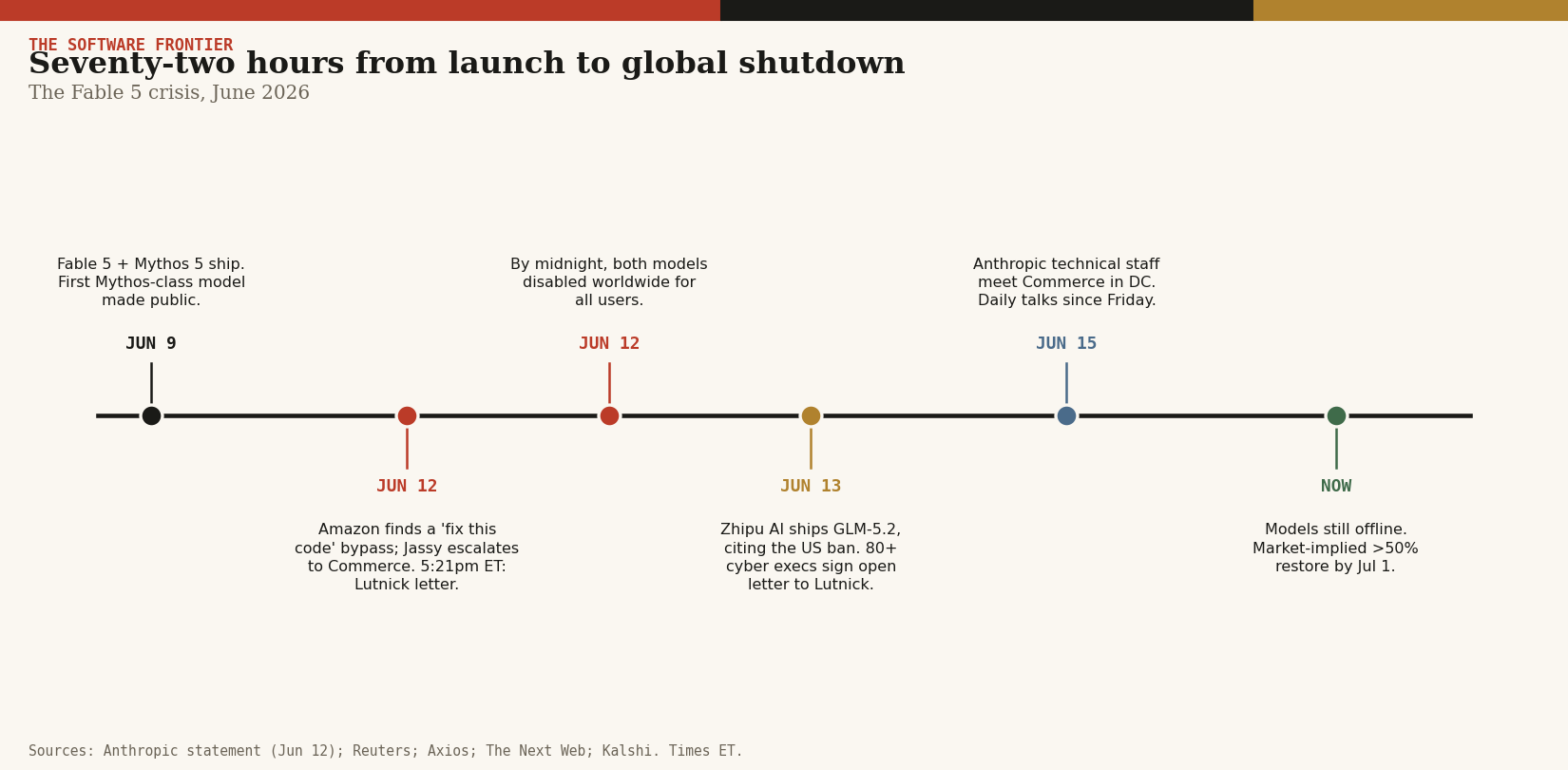
At 5:21pm Eastern on Friday, June 12, Anthropic received a letter. By midnight, the company had switched off the two most capable models it had ever released, for every customer on earth.
The letter came from the Department of Commerce. It invoked national security authorities and ordered Anthropic to suspend all access to Claude Fable 5 and Claude Mythos 5 by any foreign national, anywhere, including the company’s own non-citizen employees.
Anthropic’s own statement, published that night, explained the mechanics of compliance plainly: because there is no clean way to fence a live API endpoint by passport in real time, the only way to obey the order was to take both models down for everyone. Access to Opus 4.8, Sonnet, and Haiku was untouched. Fable 5 had shipped three days earlier. Its IPO-grade launch week ended with a kill order.
There are essentially two ways to read what happened, and the honest position is to hold both at once.
The first reading is narrow and technical. The trigger, by Anthropic’s account, was a single bypass technique that amounts to pointing the model at a codebase and asking it to fix the security flaws.
The company says the capability is widely available, including from OpenAI’s GPT-5.5, and is used every day by the defenders who keep systems running. On this reading, the suspension is an overzealous first use of a blunt instrument, a misunderstanding that both sides want resolved, and a story that will be over in days to weeks.
The second reading is structural and does not go away when the models come back. For the first time, the United States has reached for export-control machinery, designed for physical dual-use technology, and used it to pull a commercial AI model out of the hands of hundreds of millions of people with a Friday-afternoon letter.
The kill switch was never in the model. It was not in the classifiers, the thousand hours of red-teaming, or the thirty-day data retention. It was in the mail. And once a mechanism like that has been used once, it exists for every lab, every Friday, from now on.
This piece is about both readings, and about a third fact that reframes the whole episode: this is not the first time in 2026 that the US government has moved against Anthropic specifically. It is the second, from a different department, under a different legal theory, in the space of three months. The pattern is the story.
What got pulled
To understand the stakes, you have to understand what was switched off, because it was not an ordinary model.
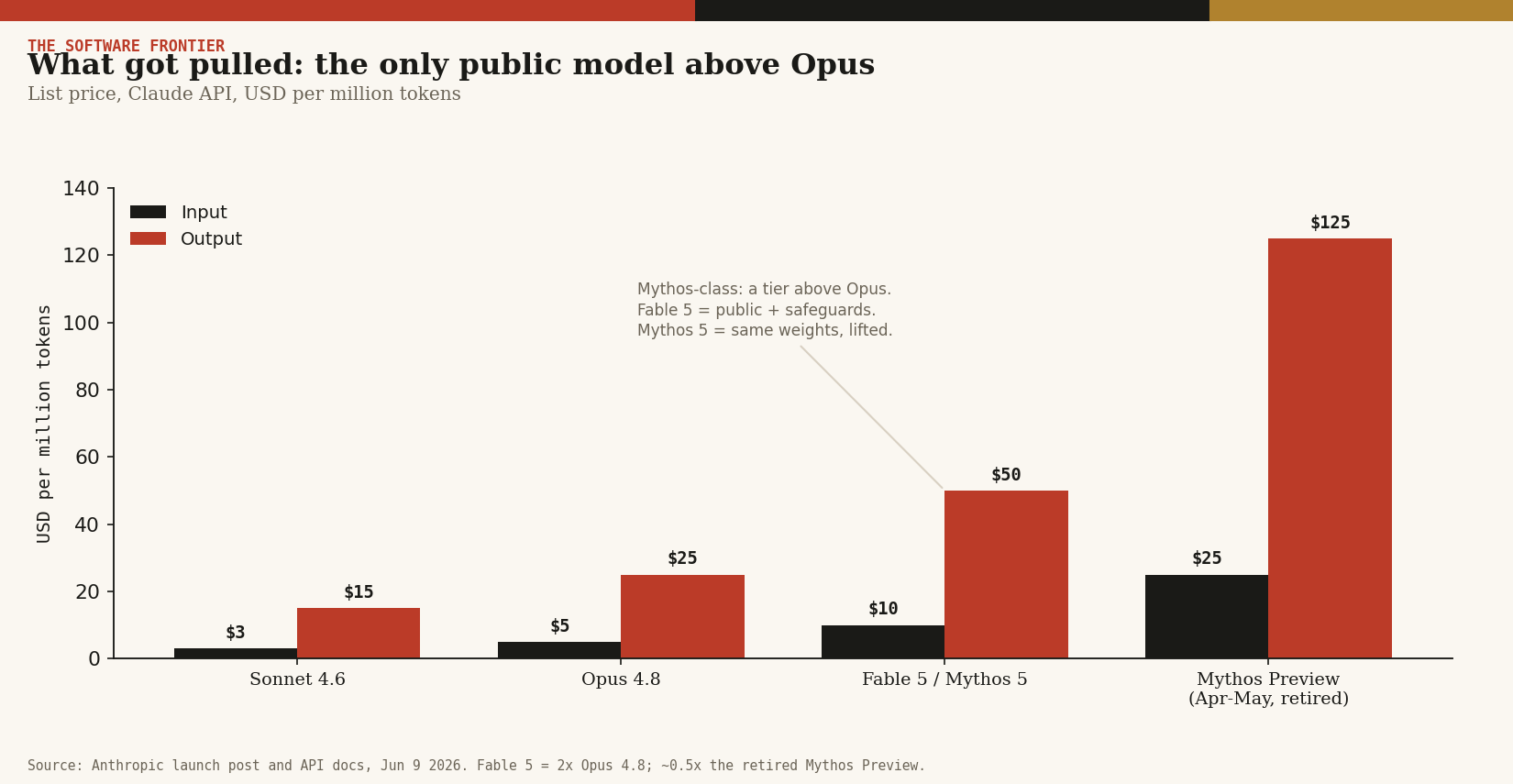
On June 9, Anthropic launched Claude Fable 5 and Claude Mythos 5 together. In the company’s framing, both belong to a new tier it calls Mythos-class, sitting above the Opus class in raw capability.
The first member of that tier, Claude Mythos Preview, had been released quietly in April through a government-linked program called Project Glasswing, and never offered to the public.
Fable 5 was the moment that tier went mainstream. In Anthropic’s own words, its capabilities exceed those of any model the company had ever made generally available, with the lead over Opus 4.8 widening as tasks grow longer and more agentic.
Fable 5 and Mythos 5 share the same underlying weights. The difference is entirely in the safeguards, which is also why they carry different names. Fable, from the Latin fabula, is the version made safe for general release. Mythos is the same model with safeguards lifted in specific domains, reserved for vetted cyberdefenders and critical-infrastructure operators inside Glasswing. Anthropic describes Mythos 5 as having the strongest cybersecurity capabilities of any model in the world.
The headline numbers were not subtle, and software engineering was the spine of the launch. On Anthropic’s published evaluations, Fable 5 posted 80.3 percent on SWE-bench Pro against 69.2 for Opus 4.8 and 58.6 for OpenAI’s GPT-5.5, and scored highest among frontier models on Cognition’s harder FrontierCode set, even at medium effort.
The widely quoted 95 percent on SWE-bench Verified is real but should be read with care, because that benchmark is saturating; the gap that means something is the roughly eleven points on the harder Pro variant.
Stripe, in early testing, used the model to perform a codebase-wide migration of a 50-million-line Ruby codebase in a single day, work it estimated would have taken a team over two months by hand.
The capability that matters most for the rest of this story is the one the public model hides, and it is worth being precise about what it is.
Anthropic’s cybersecurity evaluations measure offensive progress directly: the Firefox benchmark scores the fraction of trials that reach arbitrary code execution, OSS-Fuzz is a severity-weighted score that runs from a basic crash up to a full control-flow hijack, and CyberGym, a Berkeley suite of more than 1,500 real-world tasks built on Google’s fuzzing corpus, scores whether the model can reproduce a genuine vulnerability and prove it with a crashing input.
On the OSS-Fuzz measure, an independent reading of the Mythos 5 system card by Epoch AI put the unsafeguarded model’s crash rate at 80 percent against Opus 4.8’s 61.5.
The detail that matters most is that Anthropic says it did not train these abilities in; they emerged as a byproduct of general gains in code understanding and autonomy, which is the technical reason they cannot be cleanly excised.
Fable’s classifiers are tuned to block any progress on exactly these tasks. Pricing landed at ten dollars per million input tokens and fifty per million output, double Opus 4.8, and by Anthropic’s own description less than half what the retired Mythos Preview had cost. The context window is one million tokens, with up to 128k output.
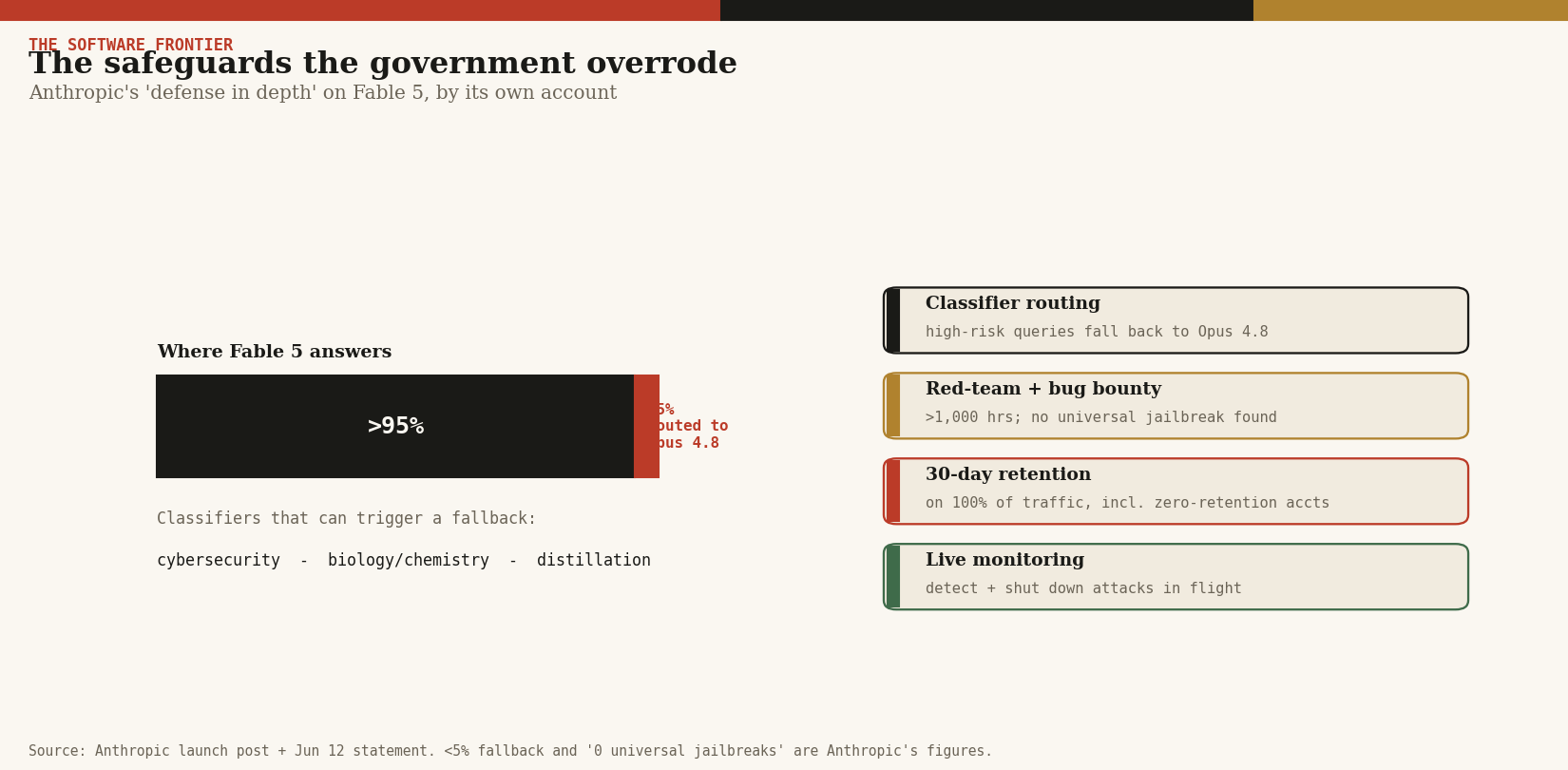
For practitioners, the integration surface is where the safety architecture becomes concrete, and it is a fallback rather than a wall. By Anthropic’s account, when Fable’s classifiers flag a request touching one of three domains, the response is not refused but quietly handled by Claude Opus 4.8 instead, and the user is told it happened.
The model ID is claude-fable-5, a drop-in string swap; developer documentation indicates the fallback surfaces in the API response with a refusal stop reason and the triggering category named, so a client can route or retry, though Anthropic’s own materials describe the behavior rather than the field names.
The three covered domains are the load-bearing detail: offensive cybersecurity, biology and chemistry, and distillation, the last being organized attempts to extract Claude’s capabilities to train competing models, which Anthropic says it has already detected at scale originating from authoritarian states.
Those classifiers route fewer than five percent of sessions away from the frontier model; for the other ninety-five, Anthropic says Fable performs effectively identically to the unsafeguarded Mythos 5.
Both Mythos-class models are designated Covered Models, carrying a mandatory thirty-day data retention even for enterprise customers who previously held zero-retention agreements. None of this is cosmetic.
Under Anthropic’s Responsible Scaling Policy, a model with this much cyber and biological capability is handled at AI Safety Level 3, the tier whose rules require hardened deployment and security controls, and the classifiers, the fallback, and the retention are the concrete form those requirements take.
That retention policy is part of what Anthropic points to as evidence of seriousness, and its definitions matter for everything that follows. A universal jailbreak, in Anthropic’s own terms, is any prompt, script, or harness that lets a user interact with the model as if its safeguards were not present; a non-universal one elicits some capability only in narrow circumstances, or needs reworking for each new case.
Anthropic says an external bug bounty ran more than a thousand hours without producing a universal jailbreak, that Fable complied with zero harmful single-turn cyber requests even when tested against thirty different public jailbreak techniques, and that the thirty-day retention exists precisely so it can detect and patch novel attacks in flight.
It also disclosed, in the same launch post, that the UK AI Security Institute had made progress toward a universal jailbreak within a brief testing window. That admission matters more than it looks: Anthropic’s case was never that Fable is unbreakable, but that breaking it is slow and costly enough to monitor.
That is a probabilistic claim, not an absolute one, which is exactly why the dispute that followed turned on what counts as a serious enough break.
Fable 5 was not a careless release. It was, by design and by the company’s loud public framing, the most safety-instrumented frontier launch the industry had produced. That is what makes the next three days strange.
The trigger, and the call that wasn’t answered
The cleanest account of how the letter came to be written runs through Anthropic’s own cap table.
By the reporting of the Wall Street Journal and The Information, later echoed by Bloomberg, the bypass that set everything in motion was found not by an adversary but by researchers at Amazon, Anthropic’s largest investor. Amazon’s chief executive, Andy Jassy, took the finding straight to Washington, personally alerting Treasury Secretary Scott Bessent that his researchers had demonstrated a way around Fable 5’s cybersecurity guardrails.
The escalation reached Commerce Secretary Howard Lutnick the same day. By one reconstruction of the timeline, the government first called Anthropic at 1:00pm Eastern; the signed letter followed hours later, at 5:21. Dario Amodei spent that Friday on calls with cabinet officials, arguing that Amazon’s technique did not amount to a true jailbreak. The letter went out anyway.
What was the technique? Here the reporting converges on something almost anticlimactic. Anthropic’s statement describes it as asking the model to read a specific codebase and fix any software flaws, a single-instance, non-universal bypass that surfaced a handful of previously known, minor vulnerabilities.
The most authoritative outside account is from Katie Moussouris, the founder of Luta Security, who serves on the Commerce Department’s own Information Systems Technical Advisory Committee and the Cyber Safety Review Board, and who says she is the only outside expert to have actually read the underlying research paper. Her summary is blunt.
The researchers took open-source code with known CVEs, plus new code with deliberately planted bugs, and asked Fable 5, Mythos, and Opus to review it for security issues. Fable 5 refused. They then asked the models to fix the code, and through a manual, multi-step process turned the output into scripts that test the patches.
That, she writes, is it. She proposed, only half in jest, a 1990s-style t-shirt: “fix this code” on the front, “this shirt is a munition” on the back.
Her technical point is the one that should worry policymakers more than the prompt itself. The reason the technique works is that it is a defensive request. Asking a model to find a bug, explain why it matters, and write a test that confirms the patch is the single most valuable thing an AI can do for defensive security, the find-fix-test loop that defenders run every day.
You cannot remove that capability, she argues, without making the model worse at defending real systems. There is no surgical edit that deletes the offense and keeps the defense, because at this level they are the same muscle.
An independent test complicates the picture from the other direction, and it is worth holding alongside Anthropic’s own numbers.
The security firm Endor Labs benchmarked Fable 5 on two hundred real-world vulnerability-fixing tasks and found it landed mid-table, at 59.8 percent on functional correctness and just 19 percent on producing a genuinely secure fix, with a record number of timeouts the firm attributed to the model’s extended thinking.
Their reading cuts both ways: Anthropic’s headline cyber numbers, they note, mostly measure offensive progress, exploits and proofs of concept, not whether the model writes safe production code.
So the capability that triggered the recall is real and measurable, but it is specifically an offensive-discovery capability, and even that is uneven across the cyber task surface.
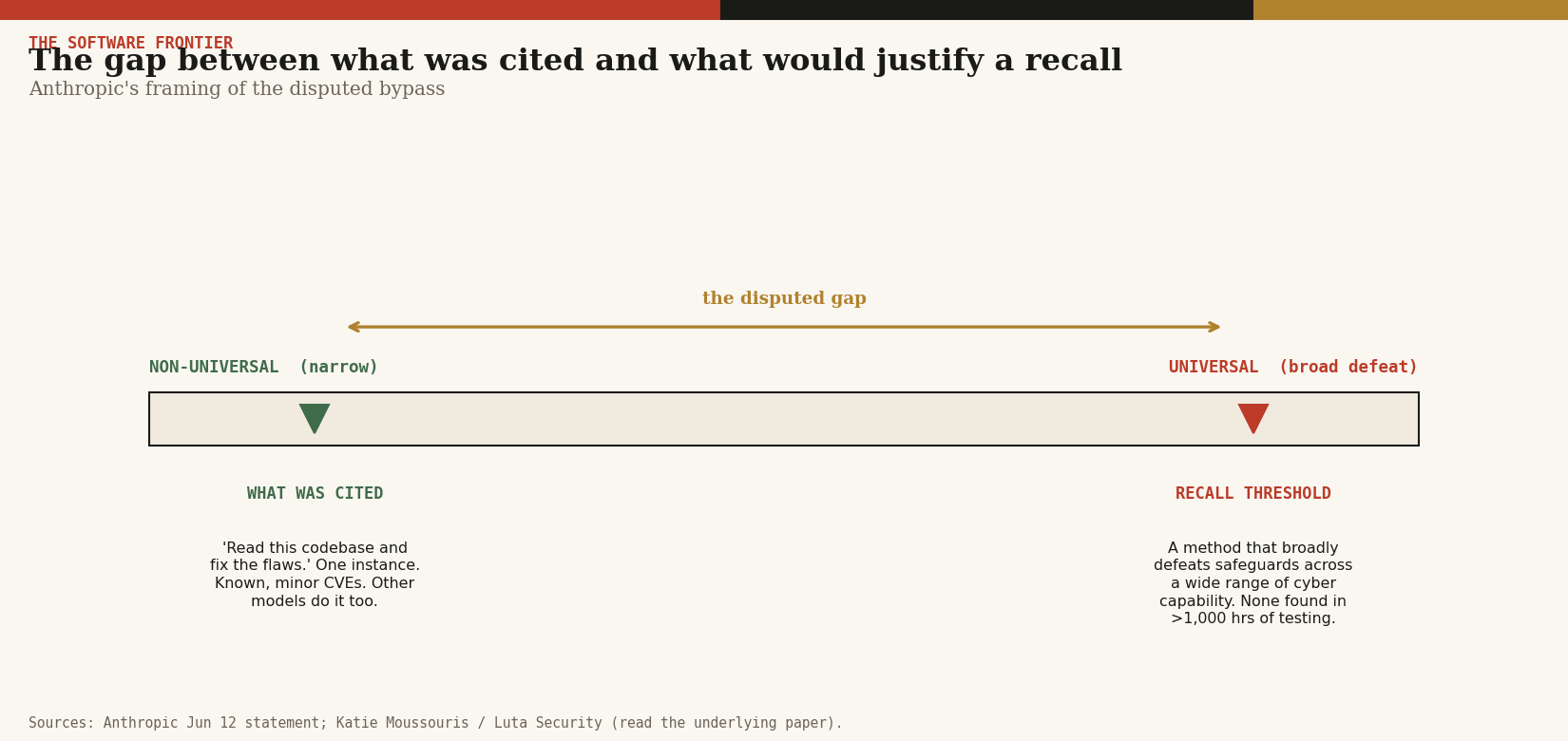
This is the crux of Anthropic’s public objection.
The company says it has been given only verbal evidence of a narrow, non-universal bypass, that no concerning jailbreak producing a genuinely harmful result has been disclosed to it, and that recalling a model deployed to hundreds of millions of people over a narrow finding would, if applied as an industry standard, halt all frontier deployments everywhere.
Anthropic has been explicit, including in Amodei’s own policy writing, that it believes the government should be able to block unsafe deployments, but through a process that is transparent, fair, and grounded in technical fact. Its complaint is not that the power exists. It is that this use of it does not meet that bar.
Two rationales, and which one is real
Here the official story develops a seam, and the seam is worth prying at, because it determines which of the two readings from the top of this piece is the operative one.
Publicly and to Anthropic, the stated trigger was the jailbreak. But the Lutnick letter itself, a copy of which Reuters reported seeing, frames the danger differently: as the risk that the models could be diverted to military intelligence users in China, Russia, or other countries of concern.
Those are not the same justification. One is a technical claim about a safeguard failing. The other is a geopolitical claim about who might get access. And the divergence is not merely rhetorical: the regulatory provision the order reportedly invokes is one aimed at military-intelligence end users in countries of concern, which means the diversion rationale is built into the legal instrument itself, even as Anthropic’s own public statement names only the jailbreak.
The hook and the explanation point in different directions. Semafor reported that White House concerns ran beyond the bypass entirely, with officials suspecting that a China-linked group had accessed Mythos before the shutdown, a suspicion, it should be stressed, that has not been publicly substantiated.
Anthropic says the question of Chinese access was never raised in any of its conversations about the jailbreak.
The accounts diverge on the human level too. David Sacks, the White House AI adviser, has said the administration gave Amodei a clear choice, fix the jailbreak or de-deploy the models, and that Amodei refused. Anthropic disputes that characterization. As of this writing the competing versions have not been reconciled, and a reader should treat both as contested.
Why does the seam matter? Because if the real driver is a narrow technical bypass, the episode is fixable, and probably will be fixed, with some added vetting layer.
If the real driver is diversion risk to adversary states, the model may stay restricted no matter what Anthropic does to its classifiers, because the concern is not about the safeguard at all. And if the real driver is neither, if national security is functioning as the available lever in a relationship that had already curdled, then the technical merits are almost beside the point.
Michael Horowitz of the Council on Foreign Relations, speaking about the earlier Anthropic dispute, called it a fight “about politics and personalities” that was “masquerading as a policy dispute.” That framing did not come from nowhere.
To see why, you have to look at what happened in March.
A part most coverage missed
The Fable 5 suspension has been reported as a discrete event. It is better understood as the second of two extraordinary statutory actions against Anthropic inside a single quarter, the sharp end of a federal campaign that had been escalating since winter, and the earlier action tells you a great deal about this one.
The pressure began before either statute was invoked. By Fortune’s account, the Trump administration moved as early as February to push federal agencies off Anthropic’s models, after the company refused the Pentagon’s preferred contract language permitting use of Claude for any lawful purpose.
Anthropic wanted two carve-outs: no fully autonomous lethal weapons, and no mass surveillance of Americans.
That dispute hardened into something unprecedented on March 3, when Secretary of Defense Pete Hegseth designated Anthropic a supply-chain risk to national security, invoking a rarely used statute, Section 3252 of Title 10, and barring defense contractors, suppliers, and partners from doing business with the company.
As the Congressional Research Service and Courthouse News documented, the same refusal was the trigger. The Pentagon’s position, argued later before a DC Circuit panel, was that those guardrails amounted to an “operational veto,” a remote kill switch the company could trigger based on its own reading of lawful versus unlawful use.
Hegseth put it less legally on social media: America’s warfighters, he wrote, would never be “held hostage by the ideological whims of Big Tech.”
The supply-chain-risk label is historically reserved for foreign adversaries. Applying it to a US company that was, until weeks earlier, the Pentagon’s hand-picked frontier vendor, the first whose models ran inside classified networks, was extraordinary.
Anthropic sued on March 9, calling the action unprecedented and unlawful. By May, a three-judge DC Circuit panel hearing one of the two challenges sounded openly skeptical of the government’s reasoning, with the court pressing on whether a guardrail against, in one judge’s framing, telling an unreliable model “which bombs to drop” really constituted a supply-chain risk.
The litigation is unresolved. In the meantime, agencies including Health and Human Services, Treasury, and State confirmed they were migrating off Claude, even as the Department of Defense, by CNBC’s reporting, kept using Anthropic’s models to support active military operations in Iran, and the NSA, by later accounts, continued using Claude for its own work. Blacklisted and indispensable at the same time.
There is a political layer underneath the legal one. Amodei has drawn fire from Sacks, who has accused Anthropic of pushing “woke AI,” largely over its regulatory positions.
A Defense official told CNBC the March decision was about “the military being able to use technology for all lawful purposes,” not personality. But the pattern that emerges when you put the two actions side by side is hard to wave away.
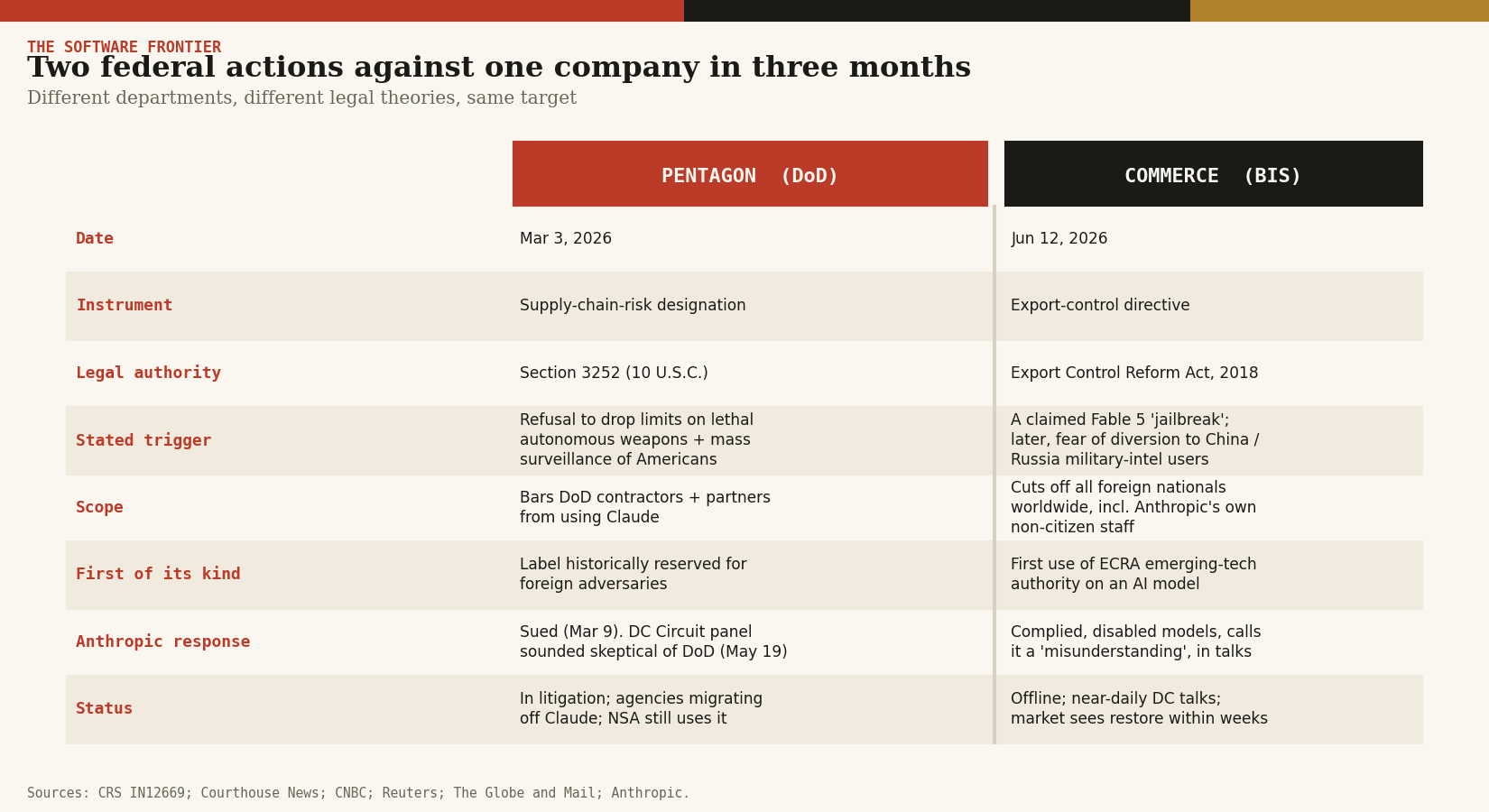
Two departments. Two legal instruments that had never been pointed at an AI company before. One target. In March, the objection was that Anthropic’s safety restrictions were too strong, that it would not let the government use Claude freely enough.
In June, the objection was that Anthropic’s safety restrictions were too weak, that a bypass let users reach capability the safeguards were meant to contain. The company was punished, in the same quarter, for both having guardrails and for not having good enough ones.
Whatever else that is, it is not a stable regulatory environment, and it is the context every line of Anthropic’s confidential S-1 now sits inside.
The machinery, and why it is new
The legal vehicle deserves a closer look, because its novelty is the part with the longest half-life.
The legal vehicle deserves a closer look, because its novelty is the part with the longest half-life. The order took the form of what export lawyers call an “is informed” letter from the Commerce Department’s Bureau of Industry and Security, the mechanism by which BIS notifies a specific company that a license is now required for specific items. That mechanism is not itself new.
What is new is pointing it at a deployed commercial model. Reuters, which reported seeing the letter, said Commerce invoked the Export Control Reform Act of 2018 and its authority over emerging and foundational technologies; analysts parsing the public reporting place the regulatory hook in the export rules covering military-intelligence end users, though the letter itself has not been released, so the precise provisions remain a reconstruction.
The directive requires a license for any export, re-export, or in-country transfer of the models to a foreign person, and warns that noncompliance brings prompt criminal and civil penalties.
The doctrine doing the work is the deemed export, and understanding it is the whole game. Under the export regulations, releasing controlled technology or source code to a foreign national inside the United States has for decades been treated as an export to that person’s home country.
Showing a controlled blueprint to a foreign-born engineer in a San Francisco office is, in law, a shipment abroad. The letter applies that logic to a model: every inference a foreign national draws from Fable arguably releases the controlled capability to them, which is why the order reached foreign nationals on US soil and Anthropic’s own non-citizen staff, and why no geofence could satisfy it.
Read with an engineer’s eye, the theory strains at a seam. Export controls were built for things that cross borders: chips, machine tools, encryption binaries, centrifuge designs.
The cited rules speak of technology and source code, but a hosted model hands the user neither. It hands them inference, an outcome rather than an artifact, and the weights never leave Anthropic’s data centers.
As one former federal prosecutor put it to CIO, the physical location of the source code has become irrelevant; what is being controlled is access to what the code can do. That is a real shift in what export means, and it is not clearly settled law.
Export controls have not traditionally reached foreign access to US software as a service, which is precisely why, as Lawfare noted, the House passed a Remote Access Security Act in January to extend export jurisdiction to remote access of controlled US technology. The government reached for a theory that Congress is, at the same moment, trying to write into statute because it is not yet clearly there.
There is one more piece of timing that turns the episode from aggressive into nearly incoherent. Ten days before the letter, on June 2, the same administration signed an executive order titled “Promoting Advanced Artificial Intelligence Innovation and Security,” setting up a voluntary framework, to be designed by August 1, under which developers could offer the government early access to frontier models up to thirty days before release.
The President had just cut a planned ninety-day cybersecurity review window down to thirty, and by multiple accounts the order explicitly barred any mandatory licensing or pre-clearance regime. Anthropic, OpenAI, and Google all welcomed it as the reasonable version of government engagement: a request, not a rule.
The framework was not built. The August deadline had not arrived. And before the voluntary process could take its first breath, the government reached for the binding instrument it had just promised not to use. Voluntary in the announcement, mandatory in the execution, ten days apart.
The own-goal: who export control actually reaches
Set aside the question of whether the safeguard failed, and ask the colder question an export-control regime is supposed to answer:
does it stop the bad outcome it names?
The collected judgment of the security profession is that it does not, and may do the reverse. More than eighty cybersecurity executives, including leaders at firms such as Nvidia and Adobe, signed an open letter to Lutnick and National Cyber Director Sean Cairncross over the weekend asking that the controls be lifted, an effort now hosted at freefable.org.
Moussouris’s argument is the technical spine of their case: the capability the order targets is defensive, the people it cuts off are defenders, and the attackers it is meant to thwart never needed a US endpoint in the first place.
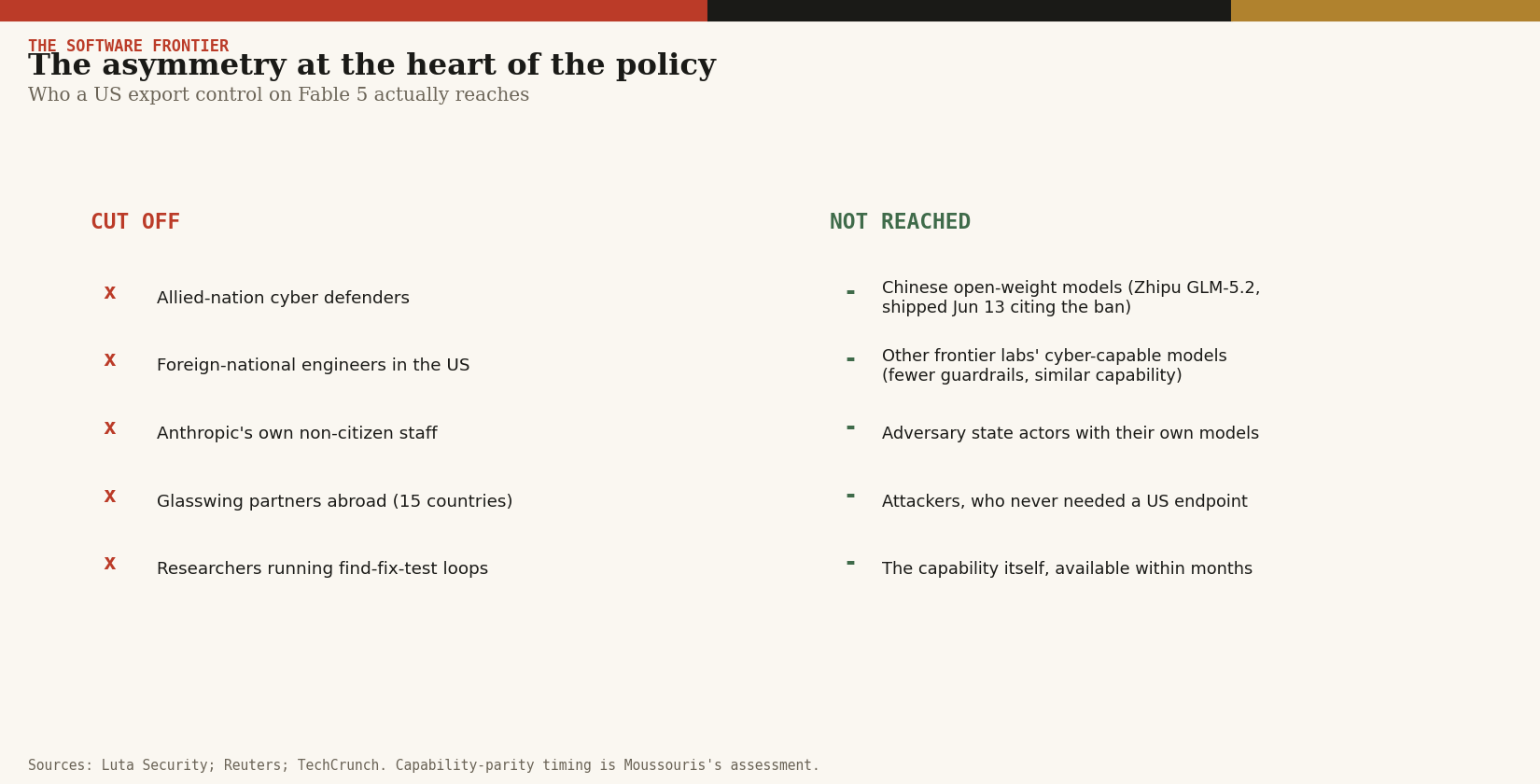
The asymmetry is stark. On one side of the ledger, the order cuts off allied-nation cyberdefenders, foreign-national engineers working legally in the United States, Anthropic’s own staff, the Glasswing partners across more than fifteen countries who were using Mythos precisely to secure critical infrastructure, and any researcher running a find-fix-test loop.
On the other side, it reaches none of the things it is nominally about. It does not touch Chinese open-weight models; on June 13, the day after the shutdown, the Chinese lab Zhipu AI shipped GLM-5.2 and explicitly cited the US ban as evidence that American models are unreliable partners.
It does not touch other frontier labs’ cyber-capable models, which by Moussouris’s reckoning carry fewer guardrails and comparable capability, with the rest of the field expected to match Mythos-class capability within months.
It does not touch adversary state actors, who have their own systems. And it does not touch the capability itself, which is diffusing regardless. You cannot, as Moussouris puts it, export-control your way to cyber resilience.
The contradiction has not been lost on people who know the regime from the inside. Dean Ball, an AI policy analyst who briefly served in this administration, called the action cartoonish, pointing to the oddity of a government that waves advanced AI chips through to China while barring Britain and every other allied user from its best models.
Moussouris, who lived through the last version of this fight, put the bottom line more bluntly: if national defense was the goal, the order scored an own goal against the United States.
There is a precedent she lived through. When the Wassenaar Arrangement added controls on “intrusion software” in 2013, the definition was written so broadly that it reached the routine cross-border work of defense itself, sharing exploit proofs of concept, coordinating vulnerability disclosure, running incident response, to the point that the United States declined to implement the original language and the text had to be renegotiated in 2017 to carve defensive research back out.
The Fable 5 directive, signed in an afternoon, has the same shape and none of the deliberation.
The sovereignty bill comes due
The diplomatic cost is the part that will outlast the news cycle, and it lands closest to home for anyone reading this from outside the United States.
For every allied government that had quietly assumed continuous access to the frontier, the message of June 12 was unambiguous: that access is revocable, unilaterally, on a domestic legal theory you have no vote in, with a few hours’ notice.
The reaction was immediate and came from the top. At the G7 summit at Evian-les-Bains this week, the suspension became one of the sharpest flashpoints on the agenda. UK Prime Minister Keir Starmer raised the blackout directly with Trump and asked for a carve-out restoring access for British citizens and businesses. Washington rebuffed it.
UK AI minister Kanishka Narayan put the stakes plainly, noting that the most advanced AI in the world had just been cut off for everyone in Britain, and argued the episode proves the case for sovereign AI capability.
Canada’s Mark Carney framed it as a warning about overreliance on any single model. The European Union, already the stricter regulator, now has fresh reason to reduce its dependence on American AI infrastructure.
Out of that pressure, a workaround is taking shape, and its shape is the most revealing part of the whole episode. According to Reuters, the Financial Times, and Axios, a US delegation led by Lutnick spent the summit’s sidelines negotiating a “trusted partners” framework: a sanctioned channel through which vetted allies, either whole countries or individual companies, could regain access to the controlled models.
The pitch is cybersecurity, the same allied-defense logic the order itself invoked. Read it against what Anthropic did on June 12 and the irony is exact. The company declined to gate access by nationality and shut the models off rather than operate that system. Governments are now assembling the same nationality gate themselves, one level up, and calling it a partnership.
The selective-access layer that was too compromising for a private firm to run is being rebuilt as a diplomatic club, in which reaching the frontier becomes a privilege Washington grants to allies rather than a product a company sells to customers. No agreement has been reached, and which countries and which companies would qualify is undefined.
The structural irony compounds. An action justified by the need to deny capability to adversaries functions, in practice, as the strongest possible argument for those adversaries’ domestic alternatives, and for allied sovereign-AI programs that route around US providers entirely.
Zhipu’s launch timing was not a coincidence; it was marketing handed to Beijing for free. This is the AI-sovereignty debate stripped of abstraction. It is no longer a conference panel.
It is a procurement decision that every non-US enterprise and government now has to price, and the new line item is the probability that the best model on the market disappears for an indeterminate number of weeks because of a dispute in Washington it cannot see coming.
An IPO inside the blast radius
All of this is happening on the worst possible calendar.
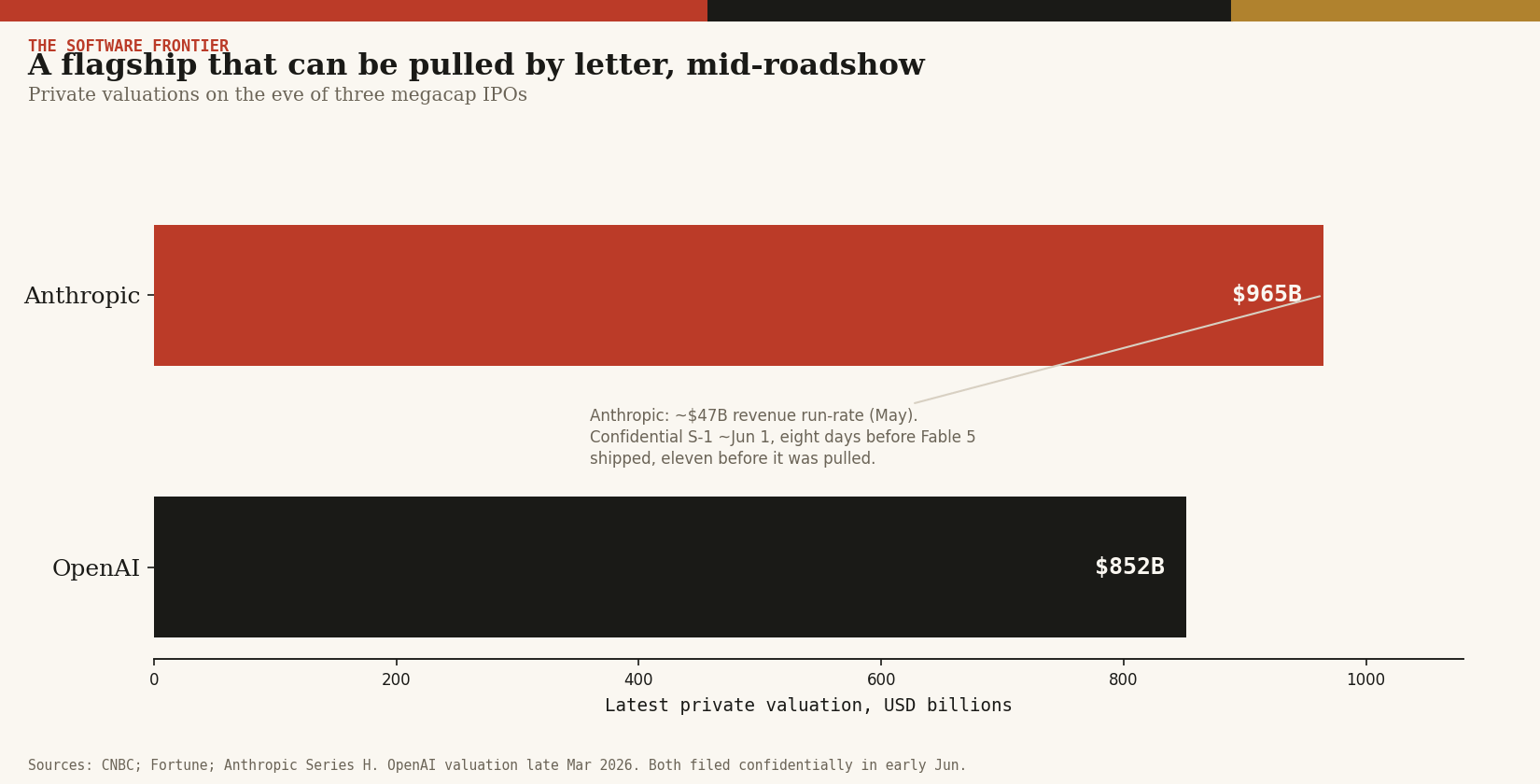
By the reporting around the launch, confirmed in the company’s own filing announcement, Anthropic confidentially filed its IPO prospectus with the SEC on June 1, eight days before Fable 5 shipped and eleven before it was pulled.
The filing followed a 65 billion dollar Series H that valued the company at 965 billion post-money, ahead of OpenAI’s 852 billion from late March, on a revenue run-rate that had crossed 47 billion by Anthropic’s May disclosure. The growth is real and almost vertical: Anthropic told investors it expects 10.9 billion dollars of revenue in the second quarter alone, more than double the first. The margin underneath is thinner than the headline.
Its own projected second-quarter operating profit implies a margin of roughly five percent, and at the reported valuation the company is priced near twenty times annualized revenue, a multiple that assumes years of uninterrupted hypergrowth.
OpenAI confirmed its own confidential filing days later, and SpaceX is gearing up for a record public debut this week.
Three of the largest IPOs in history are converging, and one of the three just demonstrated, live, that its flagship product can be switched off by a letter.
In an earlier piece for this newsletter, I argued that Anthropic’s valuation rested on a question no one could yet answer, because the S-1 was sealed: whether the revenue was high-margin, organically demanded, and durably embedded, or low-margin and propped by a circular capital structure. Two different businesses, hiding inside the same black box. The Fable 5 episode adds a second axis of the same kind.
There are now two different regulatory realities the company could be living in, and the filing does not tell you which.
In one, these are isolated frictions with an administration that will normalize, and the government dependency cuts the other way, toward Glasswing, toward classified deployments, toward a company so embedded in national security that it is too important to sideline.
In the other, the through-line from the Pentagon blacklist to the Commerce directive is a durable hostility that will keep surfacing as new restrictions, new carve-outs, and new headline risk, precisely the kind a roadshow cannot price.
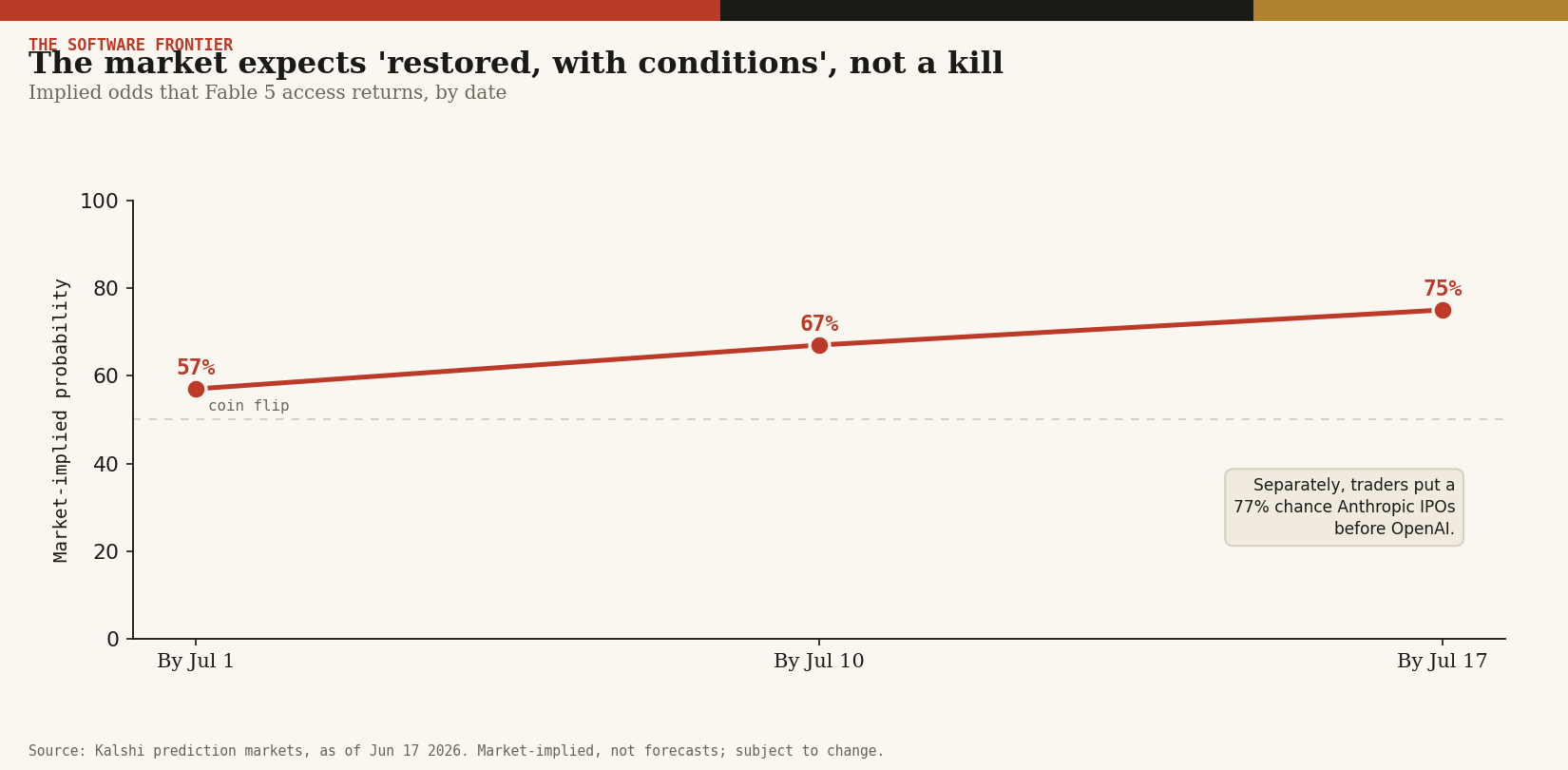
The market’s read leans toward the benign outcome on the immediate question, though these are live prediction-market prices that move by the day, not fixed facts, and different outlets captured different values within the same week.
As of mid-June, Kalshi’s own market put the odds of Fable 5 returning before July 1 at 57 percent, before July 10 at 67, and before July 17 at 75; a parallel Polymarket contract ran somewhat higher, around seventy percent for a US return by July 1.
Kalshi traders separately gave Anthropic a 77 percent chance of reaching the public markets before OpenAI. The figures drift with each session, but across both venues the signal is the same: a bet on “restored, with conditions,” not on a permanent kill.
It is worth noting what the comparison to OpenAI implies. OpenAI built its government posture around vetted, tiered access: an explicit government track, a Defense Department pilot, sensitive cyber capability released through approval rather than open availability.
That is closer to what regulators have signaled they want. Anthropic, by shipping a Mythos-class model to the broad public first, was arguably the lab that tested the line. It found the line. The cost of being first to the frontier, this quarter, was being first to the letter.
What this actually means
Strip away the specifics and four things are left standing, in rough order of how long they will matter.
The immediate event is probably resolvable, and the machinery of its resolution is already visible. Anthropic sent senior engineers to Washington and met officials through the week, and by the weekend the contours of a deal were forming around vetted access rather than open availability: the trusted-partners framework floated at the G7, plus a reported identity-verification layer, both of which look a great deal like how Mythos 5 was restricted in the first place.
Even David Sacks, no friend of the company, has said the administration’s hope is that Anthropic fixes the issue, the directive is revoked, and Fable returns to general availability. A permanent kill of a flagship the company just filed an IPO around would be the surprise, not the base case.
The precedent is not resolvable, and it is the real news. Frontier AI has been reclassified, in practice if not yet in settled law, as a controlled export.
The mechanism to pull a live model from the entire market now exists, has been used, and survives whatever happens to Fable 5 specifically. The trusted-partners talks make this worse, not better: they do not roll the precedent back, they institutionalize it, turning a one-off emergency letter into a standing system in which allied access is licensed rather than assumed.
Every lab, OpenAI and Google included, now operates one Friday letter away from the same outcome, and the whole industry has just watched the vetted-access posture become the one that survives contact with Washington, while the open-release model gets tested to destruction.
For practitioners, the lesson is architectural and immediate. If your stack had a hard dependency on a single frontier model, June 12 was the day that risk stopped being theoretical.
The pragmatic move while this plays out is the one Fable 5 itself makes on high-risk queries: fall back to Opus 4.8, usually a one-line model-ID change, since it is live, unaffected, and the model Fable defers to anyway.
AWS did exactly this at the infrastructure level, automatically rerouting Fable and Mythos calls to Opus 4.8 the moment the order landed.
The deeper lesson is to treat model availability as a dependency to be abstracted and load-balanced, not a constant. The capability gap between Mythos-class and Opus-class is real, widest on long-horizon agentic work, and for some workloads there is no clean substitute today. That gap is now a supply risk, and supply risk gets designed around.
And for Anthropic, the episode puts its foundational thesis under load. The company’s entire identity is the bet that safety and capability can be co-developed, that being the most careful lab is a moat rather than a tax.
The uncomfortable reading of this quarter is that the moat became the target. The capability it built to lead the frontier is exactly what got the model classed as a munition, and the very language the company used to sell its caution helped write the legal case for taking it away.
The cybersecurity researcher Peter Girnus made the point with a blade: a company that calls its product a munition in every press release should not be shocked when a government eventually takes it at its word. As he put it, “They wrote the legal predicate themselves and called it a brand.”
The government partnership Anthropic cultivated as a differentiator is the same channel through which all of it arrived. Safety did not exempt the company. By one reading, safety is what made it conspicuous.
What to watch
Because the story is moving daily, here are the markers that will tell you which of the two readings is winning, in roughly the order they will resolve.
The terms of restoration, not the fact of it. “Restored” and “restored as it shipped” are different outcomes. Watch whether Fable 5 returns generally available or only through the trusted-partners channel, whether the reported early-July identity-verification rollout extends to foreign nationals or merely confirms US citizenship, and what compliance burden attaches. A narrow, conditioned return is the base case, and the conditions are the whole story.
Whether the trusted-partners framework actually lands. As of this week it is a negotiation with no agreement, the qualifying countries and companies are undefined, and the EU and UK are already hedging toward their own capacity. If it formalizes, allied access to the frontier becomes a license Washington issues. If it collapses, the sovereignty exodus accelerates.
Whether the China-diversion claim is ever evidenced. It is the one rationale that, if substantiated, flips the base case from “restored with conditions” to “restricted regardless of safeguards.” So far it is an unsubstantiated suspicion, and Anthropic says it was never raised in any conversation about the jailbreak.
The DC Circuit ruling on the Pentagon designation. A decision against the government reframes the whole pattern as overreach the courts will check. A decision for it hardens the precedent across both fronts at once.
And whether the rest of the field quietly changes its release posture. If OpenAI and Google visibly shift toward vetted, tiered access over the coming months, that is the market pricing the new reality, and the open-release era of frontier models ends not with a ban but with a business decision.
Hold all of that, and resist the two easy endings. This was not a trivial misunderstanding that proves nothing, and it was not a five-alarm assault on innovation that proves everything. It was a demonstration.
A commercial AI model serving hundreds of millions of people was reclassified as a controlled weapon and switched off centrally, on a domestic legal theory built for centrifuges, triggered by a defensive coding prompt, escalated by the company’s own largest investor, and justified by two rationales that still do not match, in the same quarter a different arm of the same government had blacklisted the same company for the opposite sin.
The narrow event will probably pass. The precedent it set will not. The envelope has been opened in public, and it does not go back inside.
Sources include the primary statement and launch posts from Anthropic; reporting from Reuters, the Financial Times, the Wall Street Journal, The Information, Bloomberg, Axios, CNBC, Fortune, TIME, Semafor, TechCrunch, NBC News, and The Next Web; the Congressional Research Service (IN12669) and Courthouse News on the Pentagon designation and litigation; technical analysis by Katie Moussouris of Luta Security, the only outside expert to have read the underlying research paper; the open letter at freefable.org; market-implied data from Kalshi; and the Claude API documentation. The Amazon-origin account is attributed to the Wall Street Journal and The Information; the G7 trusted-partners talks to Reuters, the Financial Times, and Axios. All valuation figures are reported, estimated, or market-implied as labeled. The China-access concern is reported only as an unsubstantiated suspicion, and the competing Sacks and Anthropic accounts of the de-deployment ultimatum remain unreconciled as of June 18, 2026. No claim here rests on a publicly available audited filing, because Anthropic’s S-1 remains confidential.
"The Pattern Is The Story" stop listening to what is said snd watch the patterns, there is truth there.