


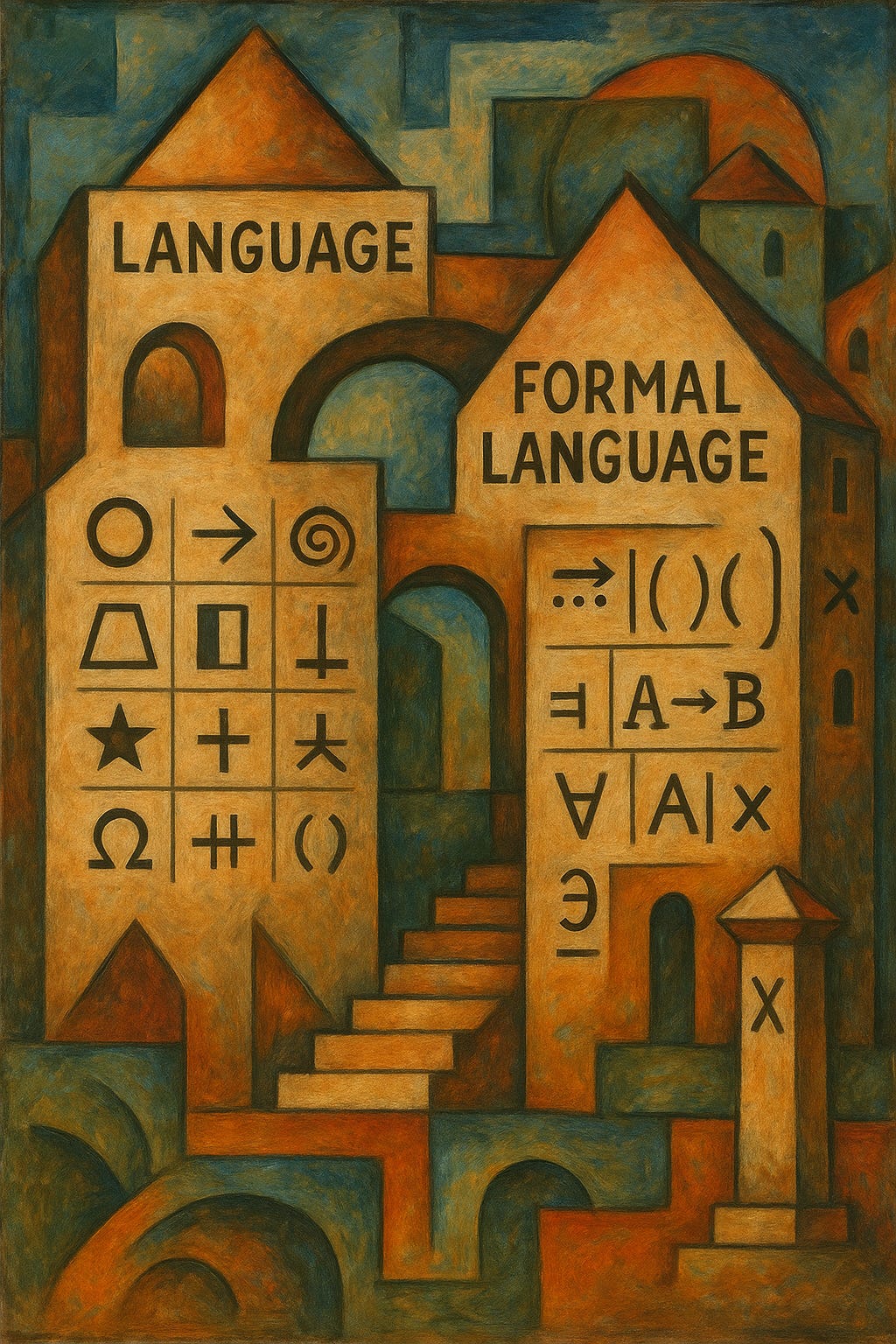
Rediscovering the Foundations
I’ve always been captivated by the intersection of language and computation, which is the place where abstract symbols, rules, and logic meet machines that execute them.
From a young age, I found something deeply compelling in the idea that sequences of symbols (letters, words, tokens) could encode entire worlds of meaning, and that a carefully crafted set of rules could transform those symbols into programs, algorithms, and functioning software.
This fascination naturally led me to formal languages and compilers, the invisible machinery that makes computation possible.
Formal languages are, in a sense, the DNA of computation. They are the rigorously defined sets of rules and symbols that allow machines to “understand” what we want them to do.
And within this space, the Chomsky hierarchy stands as a kind of map of possibility: a classification of languages from the simplest regular languages that finite automata can recognize, to the endlessly complex recursively enumerable languages that push the boundaries of what computation can express.
Each level of this hierarchy tells a story about what patterns can be captured, what structures can be parsed, and ultimately, what kinds of problems can be solved.
To truly appreciate how these abstract ideas manifest in the real world, we need to look at the tools that bridge theory and practice.
Finite automata, for example, are deceptively simple machines that can recognize patterns in strings, yet they form the backbone of lexical analysis, the first stage of a compiler.
From there, the compiler pipeline unfolds like a complex narrative: lexers identify tokens, parsers construct syntax trees, semantic analyzers ensure meaning is consistent, and code generators translate abstract instructions into executable programs.
Each step is grounded in formal language theory, and each demonstrates how something abstract and mathematical becomes practical and operational.
In this series, I want to take you on a journey through this world: not as a dry technical manual, but as a story of ideas, structures, and connections.
We will start with the simplest symbols and build toward the intricacies of compilers and virtual machines, tracing the invisible threads that connect language, logic, and computation. Along the way, we’ll explore questions that have always fascinated me:
How do formal rules capture meaning? Where does ambiguity arise, and how do machines handle it? And ultimately, what do these systems reveal about the nature of computation itself?
This is a journey into the very foundations of computer science, a chance to see the architecture behind every program and every machine, and to understand the elegance, beauty, and subtlety of the theories that make it all possible.
What Is a Language, Really?
At first glance, a language seems deceptively simple: a collection of words and sentences we use to convey meaning. We speak, write, read, and understand effortlessly, or so it seems. But even this intuitive notion hides deep complexity.
Think about natural languages, English, Spanish, Mandarin, or Arabic. Each has rules for combining words into sentences, but these rules are rarely absolute.
Ambiguity, idiomatic expressions, cultural nuance, and various forms that require context all conspire to make understanding slippery and formalizing meaning extraordinarily difficult.
A sentence like “The chicken is ready to eat” can be parsed in multiple ways depending on context. Meaning is not always inherent in structure.
Formal language theory, however, strips away this ambiguity and asks a more disciplined, precise question: What if we could define a language in a way that is exact, unambiguous, and subject to rigorous mathematical reasoning?
What would computation look like if we only worked with these perfectly defined languages? What insights could we gain about algorithms, problem-solving, and the very limits of what machines can compute?
At its core, a formal language is just a set of sentences made from symbols drawn from a finite set called a vocabulary. The sentences themselves are finite sequences of symbols, also called strings.
This definition is intentionally simple, but simplicity can be deceptive. From these modest beginnings, we can construct structures rich enough to encode any computation, from basic arithmetic to the most sophisticated algorithms a modern computer can perform.
Let’s start small. Suppose our vocabulary is V={a,b}. A sentence in this vocabulary could be as short as a single symbol, like a, or something longer and more complex, like abba or babaab. A formal language is then simply a set of such strings.
It could be finite, like L={ab,ba,aab}, or infinite, such as the set of all strings of even length. The key is that every string follows the rules of the language, whatever those rules may be.
The real elegance of formal languages emerges when we see how they capture computation. Consider the language of all strings where the number of as equals the number of bs.
At first glance, this seems like a modest constraint, but it encodes a deeper structural problem: balance. This is the same underlying challenge faced by compilers when checking that parentheses, braces, or nested blocks are properly matched.
In programming, a missing } or an extra ) can break a program, and the compiler relies on formal rules to detect such inconsistencies.
From this perspective, languages are more than sets of symbols: they are abstractions of computation itself. They allow us to describe patterns, dependencies, and constraints that machines must respect.
Every time a compiler reads your code, it is engaging in formal language processing: identifying tokens, analyzing syntax, verifying semantic correctness, and ultimately generating instructions a machine can execute.
Even with a simple vocabulary like {a,b}, we can define increasingly complex languages.
We can demand that strings follow a strict alternation pattern, or that the number of one symbol divides the number of another, or that when interpreted as binary numbers, the string satisfies some mathematical property.
These examples hint at a profound truth: any computational problem can, in principle, be encoded as a formal language. A string belongs to the language if and only if it satisfies the rules of the problem. Recognition becomes computation; generation becomes problem-solving.
In short, formal languages offer a window into the very essence of computation. They reveal the skeleton beneath natural languages, programming languages, and machine logic: a skeleton that, once understood, allows us to build tools as powerful as compilers, interpreters, and virtual machines.
They are at once deceptively simple and infinitely rich, bridging abstract mathematics and practical computing in a way that is both beautiful and foundational.
Symbols, Sentences, and the Vocabulary of Computation
Let’s zoom in on the atomic level. A symbol is the smallest meaningful unit of a language. In English, it might be a letter; in Python, a keyword or operator. Sentences, or strings, are sequences of these symbols, and the vocabulary is the finite set from which we select symbols.
There’s a subtlety here: programming languages have an infinite number of potential identifiers: variable names, function names, class names.
How does this square with the requirement for a finite vocabulary? The answer lies in abstraction: at the level of tokens, identifiers are treated as a single type.
The token “identifier” represents infinitely many possible strings, but the language only needs to recognize the category, not each specific instance.
This separation between token languages and programming languages proper is one of the first elegant insights into how formal languages make computation manageable.
The Word Problem: Recognizing What Belongs
If defining a language is about listing all valid strings, the natural next question is: How do we know if a given string belongs to a language? This is called the word problem.
For finite languages, the answer is trivial: check the string against every element of the set. But when languages are infinite, like for example the set of all strings where as equal bs, the problem becomes profound.
We need an algorithm, a procedure, to decide membership. This algorithmic lens is what connects formal languages to computation theory.
The word problem is the first place we see that a seemingly simple question: “does this string belong?” which can encode deep computational challenges.
For example, consider the language L2={ ω∈ {a,b}∗∣#(a,ω)= #( b,ω) }. We can solve the word problem with a simple Python function:
def l2(s):
    a, b = 0, 0
    for c in s:
        if c == "a":
            a += 1
        else:
            b += 1
    return a == b
Here, memory usage grows linearly with string length: a small window into the study of space complexity. Some languages can be recognized with minimal memory; others require intricate bookkeeping, revealing the deep structure of computation.
The Chomsky Hierarchy
No exploration of formal languages is complete without the Chomsky hierarchy, Noam Chomsky’s brilliant classification of languages according to structural complexity and the computational machinery required to recognize them. This hierarchy remains a cornerstone of computer science, bridging linguistics, logic, and computation.
At the base are regular languages, recognized by finite automata. These languages can capture simple patterns, like identifiers in programming languages, sequences of digits, or basic text formats. Next come context-free languages, recognized by pushdown automata, which introduce memory via a stack.
This enables compilers to check nested structures like parentheses, loops, or blocks, which is something finite automata alone cannot do.
Beyond that are context-sensitive languages, handled by linear-bounded automata, and at the top are recursively enumerable languages, where Turing machines suffice, but decidability is not guaranteed.
Each level of the hierarchy introduces new computational power and conceptual richness, linking abstract rules of language to the practical machines that implement them.
Example: The language of all strings with balanced parentheses cannot be recognized by a finite automaton because it has unbounded nesting. A pushdown automaton, however, can handle it easily using a stack: it pushes an opening parenthesis onto the stack and pops it when a closing parenthesis appears.
The stack serves as memory, tracking nested structures: a direct reflection of what compilers do when analyzing code.
Finite Automata and Pushdown Automata
Finite automata are the simplest machines in the Chomsky hierarchy. They consist of a fixed set of states, transition rules, and acceptance states.
They operate in a deterministic (or sometimes non-deterministic) manner, reading input symbols one by one and transitioning between states. Patterns such as ab* or identifiers starting with a letter and followed by digits are naturally captured by finite automata.
Pushdown automata extend finite automata by adding a stack, a simple but powerful form of memory. This enables them to recognize context-free languages, which require tracking nested structures. Imagine parsing a snippet like:
if (x) {
    while(y) {
        // some code
    }
}
The stack remembers opening braces, enabling the machine to correctly match each one with its closing brace. This is exactly how compilers perform syntax analysis, turning a linear stream of tokens into a structured representation called an abstract syntax tree (AST).
A visual illustration of a pushdown automaton reading (()()) would show the stack evolving at each step, pushing on ( and popping on ), making this invisible memory explicit.
Generation and Recognition
An elegant revelation of formal language theory is that recognizing a language and generating its strings are two sides of the same problem. Suppose we want to generate all strings in the language L2′={a^n b^ n ∣ n≥0}. Here’s a simple generator:
def generate_l2():
    s = ""
    while True:
        yield s
        s = "a" + s + "b"
Start with the empty string, add an a to the front and a b to the back, repeat infinitely. Eventually, we generate all strings of the form anbna^n b^n. The surprising insight is that if you can generate all strings, you can recognize them, and vice versa.
The connection between generation and recognition forms a backbone for understanding compilers: parsing, tokenization, and syntax checking are all forms of recognition, while code generation is, unsurprisingly, a form of generation.
Infinite Languages and the Universe Language
Imagine starting with nothing more than a handful of symbols. Just a tiny alphabet: perhaps the letters “a” and “b.” At first it feels like such a limited toolkit. But as soon as you begin stringing these symbols together, something astonishing happens.
With two letters alone you can form words of infinite length. “a,” “ab,” “bba,” “abbaabba,” and so on without end. Suddenly, from a finite seed, an infinite forest of possibilities emerges.
This infinite set is what theorists call the universe language. It is the collection of every possible string you can build from the given alphabet, no matter how long or short. Within this vast universe, formal languages appear as subsets, carefully carved out by rules and restrictions.
Some of these subsets are small, like the collection of all strings that begin with an “a” and end with a “b.” Others are infinite themselves, but still structured, such as the set of all strings with an equal number of “a”s and “b”s.
The significance of this distinction is profound. Somewhere within the universe language lies every valid computer program you have ever written, as well as every program you could possibly write.
Somewhere within it lies every balanced sequence of parentheses, every expression of a mathematical equation, every fragment of code. But scattered throughout the same space are countless meaningless strings.
A compiler’s task is precisely to separate the meaningful from the meaningless, the valid from the invalid. It must detect order in the sea of noise. When you think of it this way, writing software is not just a technical act but a navigational challenge.
We are explorers charting courses across the universe language, guided by grammars and rules that allow us to stay within the safe regions where meaning is preserved.
From Formal Languages to Practical Code
Once this picture of formal languages is clear, the leap to compilers begins to feel almost natural.
A compiler is not simply a translator of one language into another. It is an instrument designed to recognize structure in an ocean of symbols, and then to transform that structure into instructions a machine can follow.
The journey starts with lexical analysis, where the raw stream of characters is divided into tokens, like words cut from a sentence.
Next comes parsing, where these tokens are assembled into structures according to grammar rules, much like sentences being checked against the syntax of a natural language.
After that, semantic analysis ensures that the program not only fits the syntax but also makes sense. Variables must be declared before they are used, types must be respected, and scope must be consistent.
Once the correctness of meaning is assured, the compiler moves on to optimization, reshaping the program into a form that runs more efficiently. Finally, code generation produces the machine instructions that bring the original idea to life in silicon.
Each of these stages is an embodiment of formal language theory. Lexers act as recognizers, parsers as builders of structure, and optimizers as artists of transformation.
By learning the theory, you discover not just how compilers function but why they are organized in this way. You realize that each step corresponds to a distinct level of structure, and that structure itself is what makes computation possible.
Complexity, Computability, and the Philosophy of Code
Formal languages do more than explain how compilers work. They also reveal the boundaries of what is possible. Some languages are easy to recognize and translate. Others require enormous resources. And some cannot be decided at all by any algorithm, no matter how clever.
This realization is not merely technical. It carries philosophical weight. There are problems no computer can ever solve, not because we lack ingenuity, but because the very fabric of computation has limits.
Some questions are actually undecidable. Some computations demand infinite memory or infinite time. These are not bugs in the system but fundamental truths about reality.
When you write software or design algorithms, you are implicitly navigating these boundaries. Sometimes you step into regions where problems are tractable and efficient.
Sometimes you enter territories where solutions exist but require enormous computational effort. And sometimes you encounter borders that no amount of ingenuity will ever cross.
Formal language theory provides the map. It tells you which paths lead to answers, which lead to endless loops, and which do not exist at all.
Semantics and Meaning
Up to this point, much of the discussion has revolved around syntax. Which strings are allowed? Which arrangements of symbols belong to the language? Yet syntax alone is not enough. A string can be perfectly well-formed and still fail to mean anything.
Consider a program that declares a variable and then uses it in an operation that makes no sense. The compiler recognizes that the syntax is correct but still refuses to run it, because the meaning is incoherent.
This stage, semantic analysis, ensures that programs do not simply look right but actually behave correctly. It examines types, variable lifetimes, scope, and execution flow.
This division between syntax and semantics echoes the larger philosophical question of how symbols acquire meaning.
How do abstract marks on a page or sequences of electrical signals come to represent ideas, quantities, or processes? How does a finite grammar manage to capture the essence of potentially infinite computations?
These are not just engineering puzzles but reflections of the human condition. They remind us that language, whether natural or formal, is always more than form. It is about meaning, truth, and coherence.
Why This Matters
At this point, one might ask: why bother with so much abstraction? Why should anyone outside the narrow circle of theoretical computer science care about formal languages?
The answer is that formal language theory is the hidden architecture of the digital world. It explains why some programming constructs are easy to express and others are fraught with difficulty.
It explains why compilers sometimes fail in mysterious ways, and why optimization can be such a delicate art. It shows how the structure of languages shapes the possibilities of computation, and how computation in turn shapes the tools we use to think.
By mastering these foundations, we learn to see through the surface of code. We begin to understand not only what works, but why it works.
We learn to think like mathematicians when precision is required, and like engineers when creativity and construction are demanded.
Closing Reflection
Returning to these ideas after years away has felt like stepping into a familiar room only to notice details I never appreciated before. Each symbol, each grammar rule, each automaton represents more than a technical device.
It is a reflection of human reasoning, of the desire to find order within chaos, of the imagination that transforms a string of marks into a functioning program.
The deeper I go, the more I see that computation is not simply about zeros and ones. It is a story about how humans encode thought, how we build bridges between abstract logic and practical machines, and how we continually search for patterns that make sense of the infinite.
This is the journey I want to share with you. Not just a catalog of definitions and algorithms, but a narrative of structure, possibility, and meaning. Computation, at its core, is a way of telling stories with symbols. And by learning its grammar, we learn something about ourselves.