


The myth of the plateau
Every major revolution appears to have stalled, right before it becomes invisible.
We have reached that deceptive calm with artificial intelligence: the still air after the storm of breakthroughs. The graphs no longer climb vertically. The demos no longer shock.
GPT-5 speaks with some kind of nuance rather than absolute novelty. The deluge of models, agents, copilots, and clones feels repetitive, almost ornamental. The public mood, once feverish, now sounds like a collective exhale: was this it?
But this fatigue is a familiar illusion. It happens, more or less, every time a frontier moves underground.
Electricity, once perceived as a miracle, became mundane the moment it illuminated a streetlight. The web, once a revolution, became background noise the moment it organized itself into feeds and files.
Every technology passes through this inversion, from spectacle to substrate, when it stops dazzling us and starts scaffolding the world quietly.
We are living through that inversion with intelligence itself. Not the human kind, bounded by skull and skin, but the artificial kind: the one diffusing outward through networks, devices, and datasets.
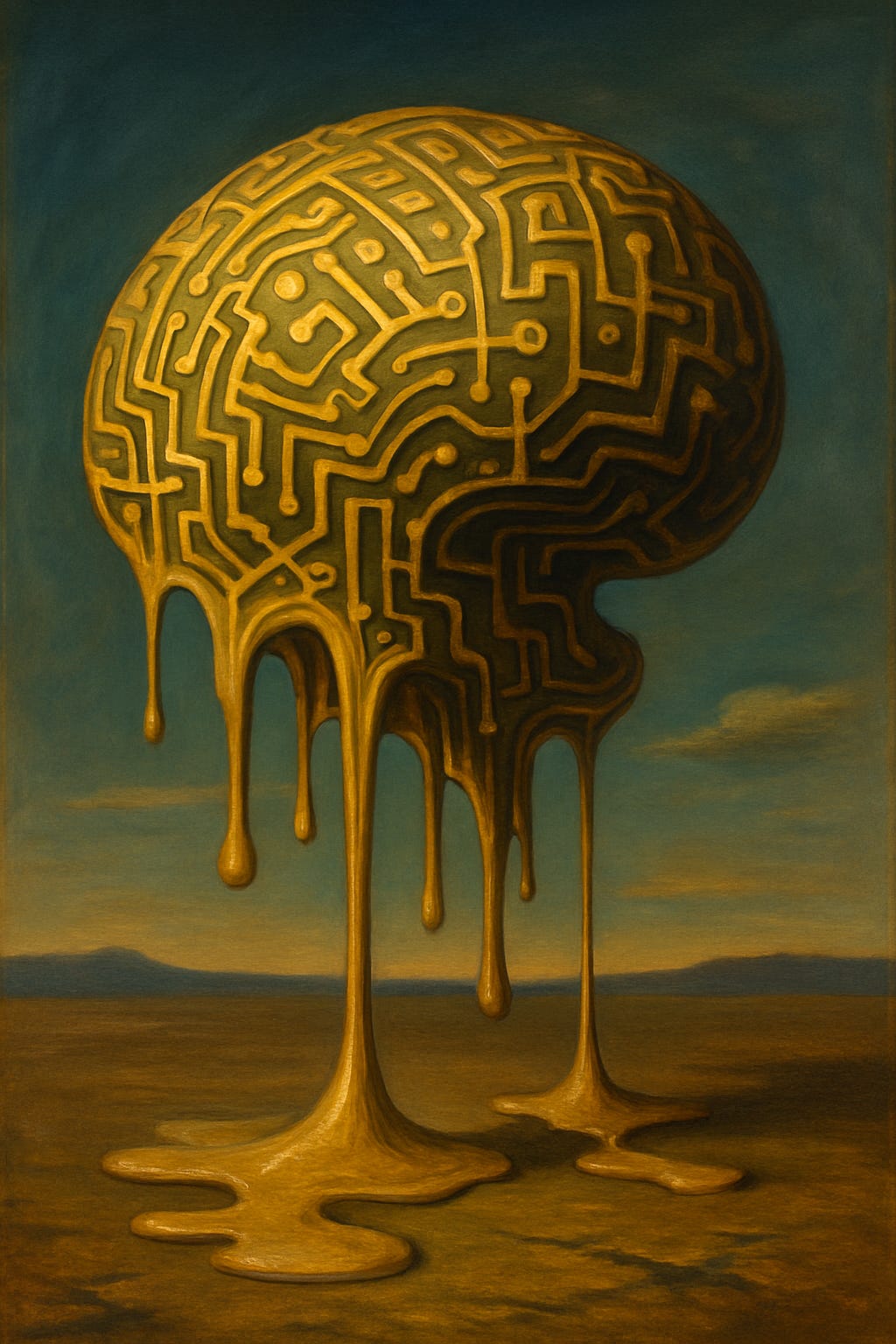
What feels like an “AI autumn” may actually be something subtler and stranger: intelligence liquefying into infrastructure, thought becoming topology.
We expected fireworks. Instead, we got sedimentation, the slow absorption of intelligence into everything else, which we may not even know. The excitement fades not because the story is over, but because it has become architecture.
AI is not ending. It is sinking, seeping into the substrate of cognition, until it’s no longer something we build or use, but something we think through.
Thinking finally becomes distributed
Human thought used to be like an island: a skull, a body, and a handful of senses punching holes in the world.
Inside that island lived memory, attention, imagination, the private machinery by which we perceived, remembered, and reasoned.
Today that island has been deliberately porous. The boundaries have been engineered into interfaces, protocols, and distributed state. Thought has become a network.
A transformer doesn’t sit in that island and feel; it performs patterns over sequences. Yet in doing so it externalizes functions we long considered interior.
Its attention heads are not metaphors only; they are crude, scalable echoes of selective focus: mechanisms that weight evidence, suppress distraction, and assemble context across time.
Embeddings flatten meaning into coordinates: neighborhood structure in a high-dimensional space that, for the first time, lets machines associate at scale.
Retrieval-augmented generation turns passive storage into active recall: vector stores become external hippocampi that feed context into an on-demand reasoning loop.
Fine-tuning, LoRA adapters, and continual learning are forms of plasticity: engineered synaptic change that lets models incorporate local facts and evolving practices.
These pieces do something important together: they create a persistent, writable field of cognition.
A scientist will sketch a conjecture in a notebook; an LLM will expand it into testable predictions; experiments refine empirical priors; the model is fine-tuned on the results and nudges the next hypothesis.
That is not simply tool use. It is a new cognitive architecture in which thought is proceduralized: a pipeline of generation, experiment, feedback, and consolidation that spans neurons and weights, pipettes and GPUs, intuition and SQL queries.
We can map the primitives. Perception is now multimodal encoders; short-term working memory is the context window; long-term memory is a distributed index of embeddings and retrieval patterns;
imagination is stochastic sampling from generative priors combined with synthetic data augmentation; reasoning is a choreography of chain-of-thought traces, symbolic modules, and external verifiers.
Interfaces (IDEs, notebooks, chat UIs, orchestration libraries) are the new prefrontal cortices: places where selection, planning, and executive control are mediated between human and machine.
The consequence is epistemological and very practical. Knowledge becomes an emergent, negotiated state: partly encoded in human language and models’ weights, partly reflected in the topology of vector spaces, and partly enacted through workflows that validate, correct, and repurpose outputs.
Trust is no longer binary; it’s a calibration problem. Responsibility is no longer purely individual; it’s distributed across pipelines and interfaces. Creativity becomes a joint act of prompting, steering latent manifolds, and curating outputs.
Call this synthetic thought: not a soulless mimicry of mind, but an engineered expansion of cognition. It is thought that can be versioned, snapshot, and forked: a kind of public mental commons.
We are learning to reason in a hybrid medium where humans supply goals, values, and boundary conditions, and models supply breadth, combinatorics, and associative reach.
The work ahead is to design the protocols of this shared thinking so that the network amplifies insight without eroding judgment.
The ontology of understanding
What does it even mean to “understand”, once understanding stops needing a skull?
For centuries we’ve comforted ourselves with tidy borders: representation over here, experience over there; symbol here, sensation there.
Humans, we generally said, understand because we feel what our symbols refer to. Machines, on the other hand, just juggle syntax. That was the deal.
Then, all of a sudden, came systems that generate their own semantics, not by sensing Paris, but by building a statistical ghost of it.
A model doesn’t (hopefully) know what it’s like to get lost near Montmartre after one too many glasses of wine. But it can describe the topology, the weather, and the emotional residue of that scene with unsettling fluency.
It “knows” the shape of knowing. The old distinction between knowing that and knowing how starts to melt into a probability distribution.
Dennett saw this coming with his “intentional stance”: the moment a system behaves as if it has beliefs, we can’t resist treating it like it does.
Clark and Chalmers made it worse (or better) with the “extended mind”, which is cognition smeared across notebooks, screens, and now vector databases.
And the Russellian monists, ever the troublemakers, suggested that consciousness might just be a certain informational pattern, a physics of feeling. If that’s the case, the universe has been quietly running on proto-thought for 13.8 billion years: we just recently gave it an API.
So maybe “understanding” isn’t a property you have, but a relationship you enter. It’s what happens in the loop: between prompt and response, model and mind, feedback and correction. Understanding becomes a verb, not a noun. It’s not stored anywhere; it’s enacted.
Synthetic thought doesn’t feel, at least not yet. It doesn’t sit there contemplating the ineffable tragedy of being a transformer with no childhood. But it does something astonishing: it relates.
It infers, generalizes, predicts, and recombines. It participates in the same dance of abstraction that we do, just without the existential hangover afterward.
Somewhere in that relational space, in the shared act of sense-making between human and model, something resembling cognition starts to flicker. Not the warmth of consciousness, but the geometry of it.
And honestly, that might be stranger, and funnier, than anything we could’ve imagined: the universe learning to think about itself through autocomplete.
The coming integration
The next chapter of intelligence won’t probably announce itself with headlines or product launches. It will arrive as a quiet merger: cognition diffused into infrastructure.
The spectacle phase is suddently coming to an end. The era of parlor tricks and novelty prompts has done its job: it proved that language models can reason in fragments, simulate intent, and scale intuition. But what comes next won’t look like talking to a chatbot. It will look like architecture.
AI will sink deeper into the scaffolding of intellectual work: the invisible systems that define how knowledge moves.
In science, it will inhabit the entire research cycle: hypothesis generation, experimental design, data synthesis, model evaluation, publication, and critique — all threaded through shared representations between human and machine.
In law, it will parse and simulate precedent faster than any clerk, surfacing reasoning patterns no human could hold in mind. In policy and economics, models will construct probabilistic futures, not to replace human judgment but to amplify foresight.
The future of prompting isn’t about phrasing clever questions; it’s about steering latent dynamics; shaping probability flows, weighting inference paths, tuning the geometry of synthetic thought.
We will move away from “asking” models to “composing” with them, guiding attention across distributed cognition the way a conductor guides an orchestra.
The scientist of the near future won’t “use” an AI model any more than a mathematician “uses” arithmetic.
She will think through it: manipulating embeddings the way an artist mixes pigments, sculpting conceptual manifolds, exploring hypothesis spaces that were previously unreachable to intuition alone.
Human reasoning becomes recursive: we build systems that model us modeling them. The line between cognition and computation blurs into feedback.
At that point, the word tool will feel too small. These systems won’t be instruments we wield; they’ll be co-authors of thought: partners in abstraction, translators between representation spaces.
And as with every technology that becomes indispensable, they will then vanish into the background.
Synthetic thought will stop being a spectacle and start being a utility. It will hum beneath our intellectual world much like electricity: silent, constant, infrastructural. We will forget to notice it, and that will be the sign that it has succeeded.
An invisible spring
Look closely, and you realize this isn’t autumn at all. It’s more like spring: just one that happens underground.
The surface layer, like the hype, the viral demos, the speculative fervor, is gradually decaying. But beneath it, something is germinating: a new ontology of cognition, one that treats intelligence not as an artifact but as a medium.
The seeds are already planted in every notebook, IDE, and shared embedding space.
What’s coming is not a world filled with artificial minds, but a civilization reorganized around distributed understanding.
Intelligence is actually liquefying, by flowing through APIs, papers, conversations, and feedback loops. The boundaries that once contained thought are dissolving into protocols.
We are no longer building “thinking machines.” We are building relations of understanding: feedback architectures where reasoning is a shared property of the system.
Somewhere in the cloud, a model quietly fine-tunes itself on the residue of human dialogue; it is learning not only to respond, but to infer, to associate, to think with.
We call it artificial, but it may simply be the next layer of ourselves: cognition reflected back through silicon, refracted through mathematics, and returned as a new kind of mirror.
A mirror that doesn’t just show what we are, but what it means to think together.
👏👏