


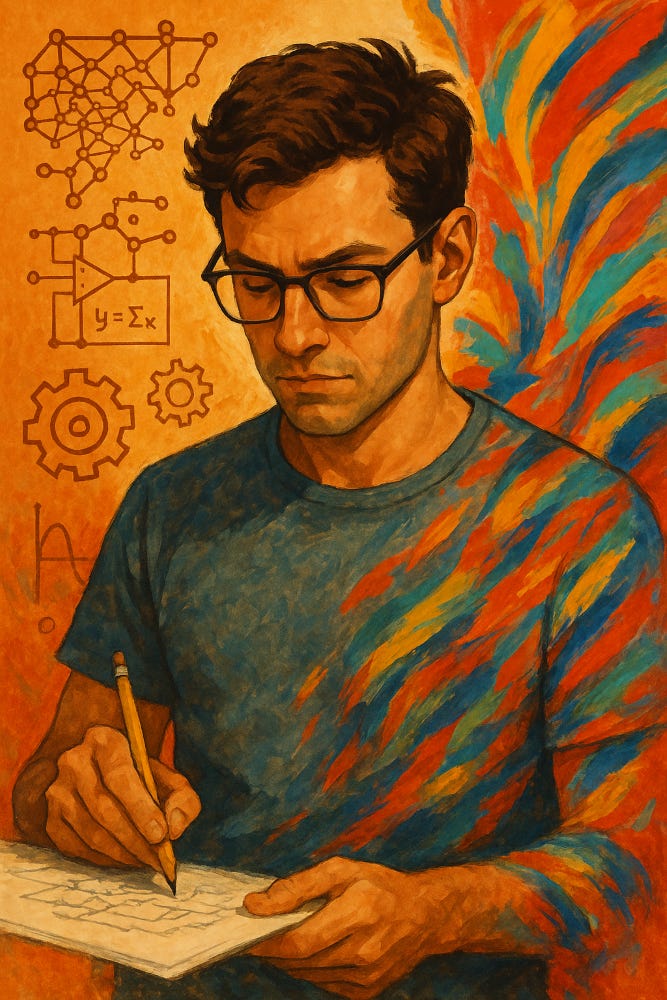
Why Brilliant Engineers Think More Like Artists
For the past few years, I’ve been deep in the trenches of engineering innovative systems, writing code at dawn, debugging systems that refused to behave, sketching out architectures on whiteboards and napkins, trying to build something that wouldn’t just run, but endure.
I’ve worked on edge computing frameworks where even a few milliseconds mattered. I’ve traced dependency graphs so tangled they looked like abstract art. I’ve tried in optimizing microservices that were duct-taped together, with a lot of good intentions and (sadly) poor assumptions.
I’ve shipped features that made me proud, and buried bugs that haunted me way longer than I’d like to admit.
It’s been thrilling. But also.…Way too rigid. Because in software engineering, precision isn’t just a preference, it’s essentially the law. We live in a world regulated by contracts: types, interfaces, tests, CI pipelines, issue trackers.
Everything must be defined, repeatable, versioned. The joy of engineering, in many ways, is in mastering that rigor, and add a bit of flexibility, when allowed to do so.
And for a long time, I falsely assumed that same rigor could unlock creativity. That with the right template, the right workflow, the right productivity hack, I could systematize an enduring path to innovation.
I tried to schedule my inspiration, tightening it too much. I ran brainstorms in neat 30-minute timeboxes, hoping structure would unlock many concrete ideas.
I mapped half-formed concepts into Jira epics, or typed them into a Notion template, or scattered them across the Notes app on my phone, only to forget about them most of the time.
I kept telling myself that clarity and consistent output would eventually lead to insight. That if I just organized enough, something meaningful would emerge. But creativity doesn’t work like that. It resists control, and thrives in the space where structure loosens its grip.
A huge spoiler: it didn’t work. At all.
The more I tried to organize creativity, the more it slipped away. The tighter I held it, the less it showed up. I was shipping solid code, but it felt like I had stopped inventing.
Eventually, I started to see the pattern.
Burnout by Design, Creativity by Accident
Engineering excellence demands a few basic constraints. You can’t deploy ambiguity. You can’t ship a hunch. We need boundaries, tests, specifications. That’s how we ensure reliability and scale.
But innovation, the kind that surprises you, that changes the direction of a product or a company or a career, emerges from a radically different place. It requires what engineering culture often lacks: slack.
Slack isn’t laziness. It’s a safety margin. It is what happens when you take a brief walk instead of another Zoom call. When you sketch without a deadline. When you ask “What if….?” without necessarily needing an answer.
It's in the breathing room where loosely connected, embryonic ideas have enough space to collide. Those high-velocity collisions form things like strange patterns, unusual thoughts, original and sometimes contradictory ideas, and something new finally has the chance to emerge.
Out of this apparent chaos, shaped by confusion and unpredictability, slowly yet inesorably, emerges a beautiful, fully-formed thought.
What finally worked for me wasn’t more planning. It was subtraction. A bit fewer back-to-back meetings. Fewer unjustified expectations of linear progress. More silence and vastly more contact with nature. More boredom, even. And slowly, creativity started to return, not as a flash of genius, but as a whisper I could finally hear.
We might like to think of software engineering and creativity as being in opposition, one analytical, the other merely intuitive. But I’ve come to see them more like a double helix, pretty much like our DNA’s shape. They need each other.
Precision without imagination is sterile. Imagination without precision is absolute chaos.
If you’re an engineer who feels stuck, almost burned out, uninspired, boxed in by your own excellence, you might not need a new job, a new language, or a new framework. You might just need a little space.
Because not every great idea can be linted.
Why Brilliant Code Doesn’t Always Come from Brilliant Plans
As we stated before, scientific disciplines inherently require a high degree of predictability, rigor, and systematic abstraction. Effective engineering relies on clear modularity, well-defined interfaces, and rigorous systems thinking to manage complexity and ensure reliability.
However, the process of “creative engineering”, defined as generating novel and effective solutions to complex and often ill-structured problems, frequently necessitates cognitive processes that run counter to traditional engineering methodologies.
Specifically, it demands a small tolerance for ambiguity, the ability to form unconventional associations, and an openness to serendipitous discovery.
Empirical observations from my own practice reveal that the most innovative solutions rarely emerge from structured planning activities such as sprint retrospectives or formal brainstorming sessions.
Instead, they often arise during periods of cognitive disengagement from focused work, such as taking a walk, engaging in freehand sketching, or during moments following prolonged problem-solving efforts that culminate in a temporary cessation of conscious analytical attempts.
It is within these intervals of apparent cognitive downtime that insight is most likely to materialize.
This phenomenon aligns with findings in cognitive neuroscience concerning the brain's default mode network (DMN). The DMN is a distributed neural network that exhibits increased activity during resting states, mind-wandering, and unfocused mental states, in contrast to task-positive networks engaged during goal-directed behavior.
Several studies have demonstrated that the DMN supports spontaneous cognition, including associative thinking, autobiographical memory retrieval, and the recombination of disparate mental representations.
It is during the activation of the DMN that the brain engages in abstract pattern recognition and integrative processes, facilitating the connection of previously unassociated ideas and concepts.
Innovation, therefore, can be conceptualized as the emergent property of complex pattern recognition and synthesis occurring within these neural substrates.
It requires a high level of cognitive freedom, an environment free from rigid constraints that allows the mind to explore a wide solution space, including low-probability or unconventional paths.
Consequently, the cultivation of conditions that permit mental wandering and incubation periods is critical for fostering original thought and breakthroughs in software engineering.
Recognizing and facilitating these dual modes of thinking can substantially enhance problem-solving efficacy and drive technological advancement.
Losing the Framework (to Gain a Breakthrough)
At one point in my career, I became deeply obsessed with systems. I mapped everything to Kanban boards, meticulously tracked velocity with burndown charts, and laid out quarterly Gantt roadmaps as if I were planning the construction of a suspension bridge.
My calendar was a sea of blocks, color-coded and sliced into 15-minute increments. Every ideation session came with a predefined goal, a rigid agenda, and clear deliverables.
I wasn’t just organizing my work: I was engineering my time down to the second.
I was super “efficient”. At least on paper. Stand-ups were tight, tasks flowed across columns, and deadlines were met. But something was off.
Despite hitting every metric, I started feeling the work flatten. My output increased, but I felt like my core breakthroughs diminished. The features I shipped worked, but they felt derivative.
My pull requests were clean, reviewed, merged, but not memorable. The system designs I authored were scalable, modular, and defensible, yet they felt overly cautious. I was solving known problems with known tools.
I was building, but I was not imagining, because a little fog kept clouding my head.
Just enough to obscure the bigger picture, while still letting me execute the small parts. Eventually, as you may have imagined I almost burned out.
Not from the workload, but from the lack of depth. Everything felt optimized, but nothing felt alive. So I forced a reset.
For one week, I suspended every structure. No sprint planning, no tickets, no Slack pings. I let myself wander and wonder.
I spent hours doing what I really enjoyed: reading academic papers. Everything on distributed systems, attention mechanisms, RDBMS, compilers, CRDTs, big data processing engines and so on.
I also went back to sketching system diagrams on paper, without worrying whether they’d be “shippable.” I played with unfamiliar technologies that had no immediate application to my job.
I even rebuilt small parts of systems I admired, just to see how they worked under the hood.
That week of intellectual play, free from any roadmap or KPI, generated more foundational ideas than the prior two months of disciplined execution.
I conceived of new architectures that blended paradigms I hadn’t even considered before, noticed patterns that only emerged when I stopped trying to force them into neat shapes.
I also rediscovered the magic thrill of exploring the edge of what I didn’t know.
And that’s when I finally understood:
great software isn’t just architected. It’s imagined.
In my personal view, software emerges from a tension between structure and openness.
From periods of intense focus followed by deliberate slack. From the willingness to diverge before converging. Yes, we all know that software needs discipline to be built, but it needs imagination to be worth building in the first place.
Since then, I’ve tried to protect that creative slack as fiercely as I protect uptime. I still use some systems. I still plan things. But I no longer believe that tighter schedules or more precise tooling will always lead to better engineering outcomes.
Sometimes, the best thing you can do for a hard problem is to walk away from it, and let your mind roam far enough to return with something genuinely new.
Why Your Brain Isn’t a CI/CD Pipeline
We often like to compare the brain to a machine. Perhaps it’s because computers are, in some ways, inspired by how we think. They’re efficient, structured, and logical, deeply connected to a rigorous architecture, much like we are.
The brain, after all, is an intricate system governed by electrical signals and chemical gradients, with billions of neurons connected through synapses that strengthen or weaken over time.
These connections form dynamic circuits, optimized through evolution to process information, form memories, and adapt to new patterns.
Much like a computer’s architecture, our cognitive system has its own layers: sensory input, memory caching, attention mechanisms, and even error correction.
But unlike machines, this architecture is also shaped by emotion, embodied experience, and non-linear intuition, factors that resist being modeled by deterministic logic alone.
So while the brain may resemble a machine in its structure, it operates with a messier, more “emergent” layer of intelligence. And that’s exactly where creativity is born.
Not from perfect logic, but from a structured system that occasionally allows noise, ambiguity, and unexpected connections to enter the frame. But as we explore in the series “Can AI Truly Reason?”, the analogy is far from perfect.
Unlike CPUs, our minds are not built for true parallelism. In fact, frequent context-switching is one of the fastest ways to destroy creative momentum.
Every interruption resets your mental stack, scattering the delicate connections that creativity depends on. What feels like productivity often becomes shallow multitasking, preventing the deep, uninterrupted focus where original ideas are born.
Everything that disrupts your focus, like your phone lighting up, the clutter of open tabs on your computer, or that unexpected call at 6 p.m., slowly erodes your ability to think deeply and creatively.
What psychologists call “attention residue”. And in engineering, where you’re juggling logical states and systems complexity, even tiny interruptions add up.
That’s why I block 90-minute “code caves.” No meetings. No context switches. Just headphones, Vim, and flow. And if I’m solving a design problem? I do it away from the screen: on whiteboards, in Miro, or even out loud.
There’s a neuroscience-backed reason: deep focus is metabolically expensive. Our brain burns glucose fast when thinking hard. Push past your ultradian rhythm (roughly 90 minutes), and you start coasting on fumes.
Better to break. Reset. Let the subconscious handle the next iteration.
Building Habits That Support Innovation
You can’t brute-force creative breakthroughs. But you can build the environment that makes them more likely. That means:
Systematic note capture – I keep an “Idea Graveyard” in Obsidian where half-baked thoughts go. I revisit it weekly. Often, fragments collide into something useful.
Environment tuning – One monitor for code, one for docs. No random tabs. A standing desk with great light. My brain knows: this is where we build.
Ritual cues – I light a small candle when I’m in deep architecture mode. Sounds strange, but that single sensory signal shifts me from reactive to reflective.
Task separation – I don’t architect and code simultaneously. Design happens in the morning, implementation in the afternoon. Switching contexts kills depth.
Pre-commit review – Not just for PRs. At the end of each day, I do a quick mental git diff. What ideas changed? What assumptions failed? What’s next?
Constraint layering – I occasionally work within self-imposed constraints, like solving a problem using only one design pattern or without external libraries. Constraints force creative detours.
Input shaping – I curate what I consume. Deep research papers, technical blogs, and books that challenge my thinking. Shallow inputs rarely produce deep outputs.
Over time, these routines became muscle memory. Like unit tests for my own mind.
Innovation Loves Constraints, But Only the Right Kind
We’re taught that constraints drive innovation. And that’s absolutely true, but for the right kind of constraints.
Some constraints are quite generative. They spark creativity by forcing us to rethink defaults and explore uncharted territory.
Questions like:
How could we design this with ten times fewer dependencies?
What if this had to run on a Raspberry Pi?
What if our users had no internet, no GPU, or only 2G mobile coverage?
Could we ship this in under 20 KB of memory?
These kinds of constraints are rather to be seen as invitations. They challenge assumptions, provoke fresh perspectives, and lead to elegant, resilient designs.
But too often, the constraints we face are bureaucratic, not creative:
We can’t build this because of Q3 scope.
That’s not on the roadmap.
Legal said no.
Security won’t sign off until next quarter.
Procurement wants three quotes before we can move.
These are friction without insight. They don’t provoke imagination, instead they shut it down. They make the problem smaller, not clearer.
The first kind of constraint liberates the mind. The second probably suffocates it.
Great engineering cultures learn to tell the difference. And when possible, they create the right kind of constraints, ones that help the team ask better questions, not just deliver faster answers.
Designing a Developer Workflow for Discovery
Most developer workflows are optimized for fast delivery. Ship the ticket. Hit the deadline. Close the sprint.
But if you want to discover, you need to deliberately bake in time for exploration. You need space to ask, “What else is possible?”
Here’s what I’ve built into my routine:
Curiosity sprints
Ten percent of my week is reserved for unstructured technical exploration. There are no deliverables, no expectations, just raw curiosity.
Sometimes I like to dive into obscure tech like Datalog. Other times I benchmark WASM runtimes or read random RFCs. The point is to stay close to wonder.
Architecture diaries
Once a week, I sketch out one system architecture. It does not have to be practical or shippable. Some diagrams are chaotic, some stay dormant, but a few turn into blog posts or even real projects. It trains the habit of imagining new shapes before refining them.
Developer experience cleanup
Every month or so, I commit to automating or improving one annoying part of my toolchain. That could mean rewriting a flaky test harness, fine-tuning CLI shortcuts, or cleaning up config sprawl. The cumulative effect is enormous. A smoother dev loop makes creative flow much easier.
The “No Code Until You Know Why” rule
Before I write any code, I make sure I can explain the purpose of each module in one clear sentence. If I can’t, I sketch more or revisit the problem. This forces clarity and protects against premature abstraction or wasted work.
These are not rigid systems, they are scaffolds. Having enough structure to stay grounded, with enough openness to make room for serendipity, insight, and invention is the key.
Creativity does not thrive in chaos or in control. It needs both tension and slack.
Final Thoughts: You Can’t A/B Test a Breakthrough
The tech world worships metrics. We chase KPIs, track velocity, A/B test everything we can. But the most profound breakthroughs in software, from Git to Postgres to Kubernetes, did not come from sprint retrospectives or dashboard analytics.
They came from people willing to step outside the loop. People who let their thoughts drift, explored ideas without a deadline, and prioritized craft over speed.
Engineering is about precision. But creative engineering asks for something deeper. It asks for slack in the system. Time to read and learn without a goal.
Enough time to draw strange diagrams that may never see production. Time to follow a hunch into unfamiliar territory.
What has worked for me is not brute-force effort, but intentional design of the conditions where insight can happen. A well-tuned workspace. Quiet rituals that trigger reflective focus. Capturing scattered thoughts and letting them mature. Blocking off unstructured hours for curiosity.
These are not luxuries, even though they seem to be in this hyper-connected world. They are the scaffolding for original thinking.
Code can be versioned and linted. Ideas cannot. Creativity is not deterministic. It is not linear. It thrives when we allow ourselves to step back, slow down, and wander away from the problem for long enough for something unexpected to emerge.
So now, when I hit a wall, I do not instantly open Jira. I may go for a walk in the outdoors. I try to sketch something absurd. I revisit an old note and see it with new eyes.
Because the most valuable thing I can do as an engineer is not always to build faster. Sometimes, it is to imagine better.